
The year of Duchamp, and Chad Elliott
5/6/2026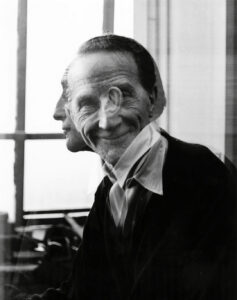
Portrait of Marcel Duchamp, 1953, printed 2006. Gelatin silver print. Des Moines Art Center Permanent Collections; Gift of Jim and Ellen Hubbell, 2020.14. Victor Obsatz
(American, born 1925). Photo credit: Rich Sanders, Des Moines
New York City’s Museum of Modern Art (MOMA) premiered “Marcel Duchamp,” the first retrospective of the controversial artist in six decades. The reaction has been overwhelmingly positive, ending all controversies about what this year’s event of year will be in the art world.
Duchamp has long been considered the third part of the Holy Trinity of artists, with Picasso and Brecht, who defined modern art after the Industrial Revolution. His reputation, though, has come with an asterisk. Unlike Picasso and Brecht, Duchamp fled Nazi-occupied Paris and moved to New York for the last 25 years of his life. That move was key to New York surpassing Paris as the center of avant garde 20th century art. It was viewed as cowardice in France, which never recovered from losing its status.
Haters tried to write Duchamp off as “political,” “conceptual” and “the father of Ready-Made.” He was best remembered for the urinal he elevated to art by redefining creativity. In his “The Creative Act,” Duchamp famously declared that “an artwork is not truly finished by the artist alone; rather, it is the viewer who, by deciphering, interpreting and reacting to the work, brings it into the external world.”
Art critics reviewing the MOMA show are falling over each other trying to rediscover Duchamp’s genius. Conceptualism is back as a buzz word. Duchamp’s “Nude Descending the Staircase,” which the artist infamously withdrew from a show in Paris to premiere in America, is finally transcending his urinal as his signature work. “Marcel Duchamp’s” 300 works play MOMA through Aug. 22, then will move to Philadelphia all fall.
In Iowa, 2026 is the year of Chad Elliott. His Weary Ramblers, with Katherine Fox, won best solo or duo act at the Memphis Blues Challenge in January, beating 140 other contestants. Elliott won “best guitar player” there, too. He is also an exciting painter of Americana. His nostalgia-rife murals are highlights of road trips through both Guthrie and Greene counties.
His Elliott Art Studio in Jefferson now offers personal instruction on Studio Tuesdays. Just bring a project or purchase a canvas at the studio. Acrylic paints are provided. $40.
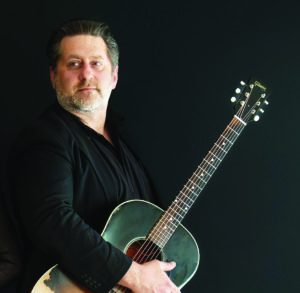
Chad Elliott. Photo by Natural Expression Photography
Visit www.dmcityview.com/lunch-with/2020/05/07/lunch-with-chad-elliott-at-ritual-cafe/ to read the CITYVIEW 2020 interview with Chad Elliott.
May touts
- Des Moines Art Center also celebrates the movement of artists and art scenes between New York and Paris a century ago with “Artists Around a Table.” Drawing on prints from the Art Center, Stanley Museum of Art, Figge Art Museum and private individuals, this exhibition depicts artists gabbing, preening, debating, smoking and drinking in the 1920s, 1930s and 1940s. Dorothy Parker would be proud. Through August.
- Moberg Gallery will feature the art of Huxley muralist Siricasso, nee Siriaco Garcia. He has more than 50 murals in central Iowa that are great fun. Moberg Gallery will celebrate his art with a three-day event that includes taco trucks, lowriders, tattoo artists, live music and an artist talk. May 15-17.
- Grinnell College Museum of Art shows “Unruly Lines: The Art of Sonja Sekula.” Sekula was born Swiss and moved to America in 1936, a few years before Duchamp. Both lived there till their deaths in the early 1960s. Sekula’s unruly lines resemble Duchamp’s in many ways. Her legacy was interrupted by frequent bouts of schizophrenia leading to hallucinations and art described as “psychedelic.”
- Brunnier Art Museum is exhibiting Norwood Viviano sculptures “that reveal patterns of change in American cities and landscapes.” Three series share space with a new commission that connects Iowa State’s agricultural legacy through cast glass architecture and topographical maps. Through May.
- Des Moines Symphony’s season finale explodes with the monumental storytelling of Richard Strauss and DMSO’s crack, 34-member brass section in “Vienna Philharmonic Fanfare” and “Alpine Symphony.” Amaryn Olmeda returns for Mendelssohn’s “Violin Concerto.” May 9-10. ♦
Jim Duncan is a food and art writer who has been covering the central Iowa scene for more than five decades.