
Healing with a horse
9/30/2026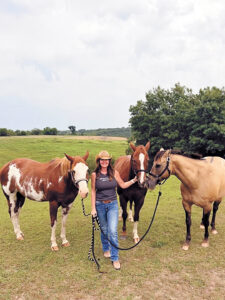
Alexis Thompson with her therapy horses.
Alexis Thompson’s life changed in an instant when she survived a horrific car accident as a young adult. The crash left her with broken bones, a ruptured tailbone and four brain hemorrhages. She was briefly confined to a wheelchair, and the traumatic brain injury forced her to leave college and begin an extensive rehabilitation process.
She tried various treatments for her brain injury, but one thing helped her focus more than anything else: spending time with a horse.
Through that experience, Thompson learned how to read horses and, in the process, better understand her own emotions and the anxiety she was experiencing.
“I didn’t realize until I started working with horses,” she said.
Her own injury, combined with witnessing the struggles of her military husband, eventually led Thompson to establish Willow Fields Equine Therapy.
Unlike traditional talk therapy, equine therapy uses interactions with horses to help clients process emotions such as anxiety, stress, post-traumatic stress disorder, depression and grief. Thompson works with military veterans, adults and children with autism and attention-deficit/hyperactivity disorder.
During sessions, clients work with horses through grooming, leading and other activities. Thompson incorporates sensory processing and the vibrations of the horse as part of what she describes as a holistic approach to healing.
“People open up more when they’re with a horse and grooming them, because they’re having an emotional experience. It helps get feelings out. It’s pretty powerful for a lot of people,” she said.
One veteran struggling with anxiety and stress was taking medication to lower his heart rate, which was 99 beats per minute.
“He was working with one of our horses who got his heart rate down to 82,” she said. “He couldn’t believe it.”
Thompson’s husband’s military service also led him to seek counseling through the Veterans Administration, but he experienced little success.
“I suggested we try something different.”
Thompson, a certified equine therapy practitioner and trauma wellness coach, began working with him through equine therapy and soon noticed a difference.
Between her husband’s transformation and her own brain rehabilitation, Thompson realized how important it can be to explore different approaches to healing.
“Because I have traumatic brain injury, a lot of times I experience instant anger, anxiety and mood shifts. I learned to calm myself before I walk up to this 1,200-pound animal,” she said. “Horses teach you to take a breath and calm down.”
Thompson says horses can hear a person’s heartbeat from about 4 feet away and often mirror the client’s heartbeat.
“That’s where that magnetic connection comes from. Horses relieve some of that stress and bring your heart rate down. They take that from you and you’re able to leave the anxiety behind,” she said.
Clients do not ride the horses. Instead, they groom, lead and work with them across 60 acres of quiet, rolling hills outside Pleasant Hill.
Three horses — Willow, Theo and Phox — are used in the therapy sessions. According to Thompson, the horses often seem to “pick” the people they want to work with.
Phox typically gravitates toward people with high energy and anxiety. Willow tends to connect with people experiencing PTSD and trauma. Theo, a rescue horse who was abandoned, ironically seems drawn to people dealing with abandonment and confidence issues.
Thompson recalls one client who was working through grief and anger.
“I thought Willow would pick her, but instead Theo did. It was different because he usually picks abandonment issues, not grief. I was surprised, but thought the horse knows best,” she said.
Two sessions later, the woman began talking about abandonment issues.
“I got goosebumps when she told me that. Obviously Theo knew that.”
After her brain injury, Thompson knew she wanted a profession focused on helping people.
“I want to bring the love,” she said.
She believes healing is not a one-size-fits-all process, particularly for people who have experienced trauma.
“It’s not a one-size-fits-all with regards to healing, especially those with trauma, like myself and my husband. If people feel stuck in their current therapy, this is a great alternative to try something different.”
Thompson also has a different perspective on what healing means.
She says healing does not necessarily mean becoming the person you were before trauma.
“Sometimes healing means discovering who you can become because of what you’ve survived,” she said.
For Thompson, that discovery came with four brain hemorrhages, a long rehabilitation process and an unlikely partner in recovery: a 1,200-pound horse.
For more information on equine therapy, visit willowfieldsequinetherapy.com. ♦
Jackie Wilson has written hundreds of articles for CITYVIEW and the Iowa Living magazines. She covers ordinary people living extraordinary lives.