
Michael Egel at Allora
5/6/2026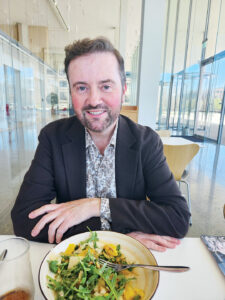 Michael Egel is the general and artistic director of Des Moines Metro Opera. We asked him to lunch recently and he chose Allora in the Krause Gateway Center.
Allora offers full lunch service now after several years of mostly morning hours with coffee and limited food offerings. Choices included panini, pasta, soups, salads and two entrees — cod and lamb osso bucco on our visit. Allora is run by Mike LaValle, who has run the opera’s food tent for decades. Recipes are from three generations of his family, including Lisa LaValle’s soups from the wind-grieved Trellis at the Greater Des Moines Botanical Gardens.
Ingredients come from local gems including South Union breads, Berkwood ham, and La Quercia prosciutto. Krause family wines, from their Italian vineyards, and desserts from Lisa’s ken are also available. Over generous servings of salads and sandwiches, we talked about DMMO’s astonishing success, its new season and its against-the-wind philosophy.
Egel succeeded Robert Larson as artistic director. That is two leaders in 54 years. That’s astonishing continuity in the art world.
“I began as an intern with the opera in 1994 when I was a student at Simpson. I did just about every job. I cleaned the bathroom floors after intermission. I literally raised the tent outdoors. Once, during a production of ‘Carmen,’ I pulled the curtain and then went on stage as an extra. In 2010, I became artistic director, and in 2013, I also became general director.”

Was there also continuity in the mission?
“Yes. The hub belief of the founding mission was to be a place for development of skills, to foster a haven that people would return to year after year and to produce shows to be proud of, productions that look like the music.”
DMMO regularly attracts elite art media — New York Times, New Yorker, Opera magazine, Wall Street Journal, etc. No other Iowa entity has anything close to that pull. How do you keep doing that?
“Survey after survey tells us the same thing — it’s our theater and its intimacy. I go to Covent Gardens (London) and Paris Opera and watch performances in 3,000-seat auditoriums. There is no intimate relationship between performers and audiences. Backstage at those operas has no glamour. It’s more like something out of Kafka.
“Our theater has 467 seats. New Yorker’s (magazine) Alex Ross wrote that ‘opera here is more like theater than it is elsewhere.’ I had not thought about that before, but it’s right. You can’t see facial expression in the huge opera halls of Europe, New York, etc. Our audiences can see sweat on a performer’s brow. That is why our audiences return year after year.”
DMMO’s audience is uniquely catholic, more so than other Des Moines entities.
“Forty percent of our audience comes from outside the central Iowa metro area. We had ticket buyers last year from 42 states and six foreign countries.”
DMMO is also unique in that it has remained successful without pandering to the shibboleth that audiences only want to see the classics.
“We have sold 93% of all seats year after year without having produced an Italian opera in 10 years. When we do ‘Tosca’ this year, it will be a fresh performance. The last time we did it was 2009. The Met does ‘Tosca’ nearly every year. (More than 1,000 times so far). They might list five different performers in every role. They recycle the production values — same sets, same costumes, etc.
“In my 18 years, we have never repeated a production. We do three operas a year, and every production is 100% fresh. This is not instant opera. We recently produced our first Hungarian, first Czech, first Russian and now our first Polish opera. I have committed to do one, and even two operas a year that are new to us. We champion the first third of the 20th century – Bartok, Juracek, Dvorak, etc. We even did Debussy and Richard Strauss in the same year.”
DMMO has also championed lesser known composers of the Classical Era.
“Gluck has a home here. The opera I am proudest of is ‘Platée’ (by early 18th century’s Jean-Philippe Rameau).”
The costumes in that were fantastic. We called it the ‘Pretty in Pink opera.’ It must be hard to cast when you do three, and just three, totally fresh shows.
“Visas are a lot of work. I cast three or four performers each year who need visas and three or four Americans who live in Europe.”
Why do so many American singers move to Europe?
“Particularly to Germany. Germany has by far the biggest audience for opera. Going back to the 1950s and 1960s, American singers, even the very best like Renee Fleming, had to do Europe. Germany produces so much opera that the state signs singers to ‘festival contracts.’ Those make them government employees with all the benefits government workers get in Germany. It’s easier now for American singers to make a living in Germany.”
Let’s go through this year’s repertoire.
“ ‘King Roger’ is our first Polish opera. It’s by Karol Szymanowski, from first third of the 20th century. It is concise — three acts in just 80 minutes. It comes from a time between two world wars when Europe was looking to find order amidst chaos. Each act reflects a different culture’s music — Byzantine, Islamic and bacchanalian Greek.”
It’s a rare opera in which the hero is a baritone. “Mice and Men” also casts a baritone in a co-lead role – John Moore.
“He is another Simpson grad. Now he’s a star. New York Times called ‘Of Mice and Men’ the first truly American opera since ‘Porgy and Bess.’ It’s a co-production with Houston Grand Opera. Composer Carlisle Floyd’s career was based in Houston Grand Opera.”
Tosca is what I call your “money shot.” It’s such a tear jerking, beautifully sung opera. Tosca is the ultimate diva. Her character is actually a diva.
“It’s pure Puccini. Uniquely written in three acts all set on the same day in Rome. In Rome, you can take a tour of the three historic venues in which it is set.”
DMMO’s promotional photo of “Tosca” star Laura Wilde on the rooftop ledge of World Food Prize headquarters is mesmerizing.
“We are proud of all three operas’ promotions. Ben Easter is a great photographer, and Kim Dragelivich does the creative design. I think our ad in Opera magazine is the best looking ad in the whole magazine.” ♦
Jim Duncan is a food and art writer who has been covering the central Iowa scene for more than five decades.