
One true non-AI sentence for Father’s Day
6/3/2026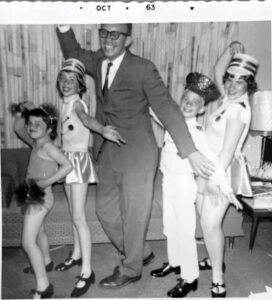 Listen, it’s going to look like I’m talking about Artificial Intelligence (AI), but don’t run for the hills, don’t wring your hands, don’t fret. Father’s Day is coming up. So I’m really going to talk about my dad. Trust me.
Let’s start with my dad.
“Mankind has seen only a few occurrences which have been so momentous as to change the direction of civilization.”
My dad wrote these words back in 1974 for the International Journal of Mathematical Education in Science and Technology. Yup, this apple fell far from that tree.
My dad, Gerard Weeg, then lists three civilization changers: the written word, the printing press, and the Industrial Revolution.

And then he gets to his point: “To this list I suspect we must one day add the creation of the digital computer and all that entails.”
Well, of course he would add that. Computers were his baby back when there was only mathematics and engineering to undergird this new thing called computer science. And he was the director of the fledgling computer center at the University of Iowa in the 1960s and eventually the chair of the brand new University of Iowa Department of Computer Science.
And let’s not forget that he was the father to eight kids, which made him mildly crazy. Or was he crazy beforehand? Pay your money and take your choice.
In any case, my dad goes on to say in the article: “The overwhelming conclusion is that the human being is left with the creative tasks, the challenging work, the inspiring work, while the computer can handle the drudgery, tedium and repetition.”
Hmmm… Hey, Siri, how did that turn out?
Yup, today the computer can both do a task and learn on the fly — just ask Siri. And we have Generative AI that goes the next step and allows the computer to actually create original content. So where does that leave us humans who, as my dad said, are supposed to do the “creative tasks, the challenging work, the inspiring work”?
My former colleague at the Polk County Attorney’s Office, Paul Houston, was always a good photographer, but he has become even better in retirement.
 Paul wrote me recently about the use of AI in photography. He gives the example of photos he took of two police K-9s and their handlers — Police Officers Martell and Bolin. He took the photos of the officers separately, but, with the help of AI, he was able to combine the two photos and place everyone together in front of a squad car — and then Paul threw in a sunset as background. Amazing.
Admitting mixed feelings about the use of AI, Paul says that it does allow “photographers to experiment with backgrounds, lighting and concepts that would otherwise be difficult, expensively or flat-out impossible to achieve.”
As an example, Paul writes of the difficulty of trying to get these two German Shepherds together for the photo. Imagine that mess.
“I know this kind of technology makes many traditional photographers uneasy. The camera still captures the truth of a moment — but AI allows us to reinterpret how that truth is presented. For those willing to embrace it, it becomes just another tool in the kit — one that expands both vision and possibility.”
I like that.
But I wonder how AI is going to be used in fact — as a tool or will we humans be tooled? In my experience, when we are left with an easy way to do something or a hard way, we choose easy. Every time.
Which gets us to Earnest Hemingway.
In “A Moveable Feast,” Hemingway describes having difficulty with writing a story and how he would reassure himself not to panic — “All you have to do is write one true sentence.”
Well, hells bells, how can a sentence ever be true if it is generated by AI?
So I complained to my wife about people using AI to write legal briefs and magazine articles and even Father’s Day cards. I said it was cheating. My wife, always the lawyer, asked whether her editing of my work was cheating. Or when I look up a phrase on the computer, am I cheating? Or when I’m researching on Google and it leads me to change my entire article, is that cheating?
I hate slippery slopes.
OK, if AI helps you write your one true sentence, bravo. But if AI generates that one true sentence, it is no longer a true sentence. Period. But how the heck is the reader ever to know whether they are getting a data dump or a sentence from a beating heart? And does it matter?
It matters for the writer because AI cuts off all the joy and all the pain and all the catharsis of creativity. And it matters to the reader if it is a barrier to connection.
Or, as my dad frequently loved to say to those folks who were frightened that computers would strip away humanity, “Remember, with a computer it is always about what you put into it. If you put garbage in, garbage comes out.”
Of course it is getting more and more difficult to distinguish rotten vegetables from fresh produce. But the writer always knows. And the reader? Perhaps they can smell it.
And my dad? He liked to joke. A lot. And only corny jokes.
“Inch Me and Pinch Me went down to the lake. Inch Me fell in, who was left?“
And all eight of us kids scattered to the winds before he could get to the end of this well-worn joke.
Could he spice up this lame joke with the help of AI?
Of course. But he died on Easter Sunday, 49 years ago, long before we all had computers in our pockets.
By the way, those eight kids he left behind say little to their grandkids about computers — but they do say, “Inch Me and Pinch me went down to the lake…”
Now there’s one true sentence for Father’s Day. ♦
Joe Weeg spent 31 years bumping around this town as a prosecutor for the Polk County Attorney’s Office. Now retired, he writes about the frequently overlooked people, places and events in Des Moines on his blog: www.joesneighborhood.com.