
The American buffet on steroids
9/2/2026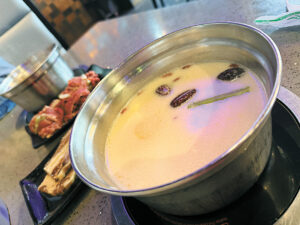
KPOT
7105 Mills Civic Parkway, West Des Moines (across the street from Costco).
thekpot.com
Sunday to Thursday, noon to 10 p.m.
Friday and Saturday, noon to 10:30 p.m.
Each August, old friends call while in town for the Iowa State Fair. They want advice about where to eat when they are not eating at the fair. This year, I was asked about KPOT more often than any other restaurant. I don’t visit all-you-can-eat (AYCE) buffets as much as I used to, but it was time to check out KPOT because they are both the hottest buffet in America and the most talked-about restaurant in nearly every town where they open a store.
AYCE buffets are an American invention. They had a precedent in the smorgasbord, which was carried to America by the Swedish pavilion at the 1939 World Fair. But El Rancho Vegas is credited with the first AYCE buffet when employee Herb McDonald talked his bosses into sponsoring a late-night experiment in 1946. It cost $1 and justified its losses by keeping customers awake long enough to gamble all night. Only in America, and only in Las Vegas, could such an icon of excess and gluttony have been invented.
In Iowa, Alvin “Caroll” Meyer opened Gold Buffet in 1958 in a Winterset bowling alley. For more than three decades, it was probably Iowa’s most famous restaurant, advertising frequently on radio and TV. It grew to 350 seats and expanded to an even larger location in North Kansas City, also attached to a bowling alley.
This century, AYCE buffets have become Asian-dominated. Chinese versions chased most of Des Moines’ marvelous independent Chinese restaurants away. South Asian versions are included in most Indian, Pakistani and Nepalese restaurants here. I have embraced the latter because they give me a chance to sample small bites of many dishes.
To comment on KPOT, I first visited Hibachi Grill Supreme Buffet in West Des Moines for context. “Supreme” is a warranted adjective. The place has 13,000 square feet and seats 430. The buffet promises “over 250 dishes” seven days a week. I don’t doubt that. It also has a large koi pond with “don’t feed or throw coins to the fish” signs.
Four soups tasted of true stocks. Sushi offerings were supermarket quality at best, with little actual fish. Salads combined Asian with American expectations. Fried foods were quite good, especially fish. “Steak” was what I call pot roast but an excellent buffet choice that stayed tender in its heated pan.
 When the local KPOT opened in November 2024, people reportedly waited up to an hour to be seated. So, we went for a 4 p.m. dinner and were immediately seated. The restaurant occupies 5,500 square feet but lists no capacity, even by the fire marshal. Yet it feels as big as Hibachi, probably because it’s almost entirely dining areas with huge booths and tables, tall chairs and only one small table offering self-service “sauce bar.” All tabletops included multiple burners and a grill.
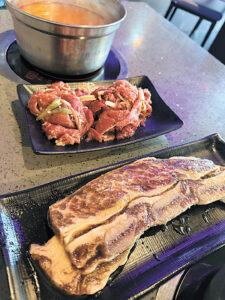
Diners order from a hot pot menu, a BBQ menu or both. A choice of eight hot pot bases included excellent “heathy herbs” and Szechuan broths. Hot pot ingredients included 69 options, and BBQ had 32. The difference was largely a number of items that should not be grilled, such as noodles, rice, leafy greens and bamboo shoots.
Baby octopi on the BBQ menu were served raw. We were told not to cook them in the hot pot, but we disobeyed. I was taught to always parboil octopi 20 minutes or longer before grilling. Same thing with calamari. This made us wonder how much training the waitstaff has.
Overall, meats were superior to what I have found at Hibachi and casino buffets. Beef belly, pork belly, pork cheeks and beef tongue were nice surprises. Steak was ribeye.
KPOT dinner cost $38 with both hot pot and BBQ options, compared with $19 at Hibachi. The price was justified by superior ingredients. It was also more fun to cook. I missed the self-service aspect, especially after being told that we could not have half orders of ingredients, no matter how much food went to waste. ♦
Jim Duncan is a food and art writer who has been covering the central Iowa scene for more than five decades.