
‘Mortal Kombat II’ delivers button-mashing delight that will leave movie-goers feeling ‘toasty!’
6/3/2026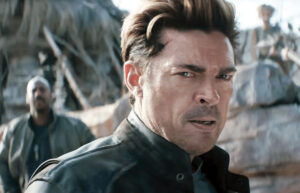
“Mortal Kombat II”
R | 1 hour, 56 minutes
Director: Simon McQuoid
Writers: Jeremy Slater, Ed Boon, John Tobias
Stars: Karl Urban, Ludi Lin, Jessica McNamee
When the “Mortal Kombat” big-screen reboot bludgeoned its way into the mainstream back in 2021, it carried the weight of a pandemic-weary audience looking for pure, unadulterated escapism. While it offered flashy choreography and a highly anticipated dose of R-rated gore, it ultimately stumbled over its own self-serious tone, an overly long origin story, and the controversial choice to center the narrative on an entirely original, somewhat bland protagonist.
Fast forward to 2026, and director Simon McQuoid has returned alongside screenwriter Jeremy Slater for “Mortal Kombat II.” Impressively, and almost apologetically, this sequel is deadset on correcting the course of its predecessor. Loud, aggressively bloody and wonderfully unpretentious, “Mortal Kombat II” makes no claims to be high art. Instead, it fully embraces the chaotic, violent and inherently absurd spirit of the Midway/NetherRealm arcade fighting franchise, delivering a crowd-pleasing roller coaster that operates at a relentless pace.
The film does well dropping the heavy exposition, bypassing the need to justify a cross-dimensional martial arts tournament. Earth’s realm is in peril, the stakes are cosmic, and the script wastes no time getting to the action. For audiences who haven’t seen the 1995 original or the 2021 reboot, don’t worry, you’re still ready for it; only an appetite for carnage is needed. The story opens with a brutal, breakneck clash between the warlord Shao Kahn (Martyn Ford) and King Jerrod (Desmond Chiam), instantly signaling that the bone-snapping, eye-gouging and spine-ripping excess has been dialed.
Someone clearly entered the blood code for this one.

With the arrival of Johnny Cage (Karl Urban) the franchise seems to have found its comedic “good guy” version of Kano (Josh Lawson). Rather than being a pristine, A-list Hollywood megastar, he is introduced as a washed-up, slightly bitter 1990s martial arts actor surviving on nostalgia and the comic convention circuit.
Cage completely steals the show, firing off razor-sharp one-liners, leaning heavily into campy, self-aware humor, and tossing out brazen pop-culture references ranging from “John Wick” to “The Lord of the Rings” and Voldemort. Though his native Kiwi accent occasionally slips through the cracks of his cocky American persona, it is forgivable given the sheer amount of charisma he brings to the screen. A fictional archive clip from Cage’s past film, “Uncaged Fury,” shows exactly who the character is without any unnecessary exposition for those who may be looking down at their phone.
As mentioned, Cage’s comedic energy is matched brilliantly by the resurrection of Kano. Pivoting to a quick control z on death, the movie brings back their strongest comedic asset. The onscreen chemistry and shared frames between Kano and, really, any of the characters provide an essential structural ballast, offering hilarious, irreverent breathers from the film’s apocalyptic stakes.
Conversely, the rest of the has more diminishing returns. Kitana (Adeline Rudolph) emerges as the genuine emotional anchor of the film showing her personal journey as a secret rebel aiming to overthrow Shao Kahn. Rudolph plays the role with an elegant, razor-sharp precision, carrying the plot forward when the performances around her falter. Her companion Jade (Tati Gabrielle) however, is less compelling, as the character is saddled with a flat performance and an unlikable, clunky betrayal-and-redemption arc that struggles to land.
Where Mortal Kombat II triumphs, however, is in its arena spectacles. While the 1995 version possessed an endearing, ensemble camaraderie and occasionally charismatic performances that papered over its limitations, it lacked the game’s true mechanics. The 2026 sequel reverses this dynamic entirely. The storytelling glue is thin, but the combat sequences are an absolute masterclass in fan service.
“Mortal Kombat II” functions as an apology for the sluggish pacing of the 2021 entry, trading somber world-building for hyper-violent, self-aware fun. It leaves the door wide open for future installments, strategically keeping its necromantic plot-movers like Quan Chi (Damon Herriman) alive to facilitate inevitable resurrections. While it lacks the heart and genuine character chemistry of the 1995 classic, it compensates with peerless, blood-drenched spectacle and a spectacular turn by Karl Urban. ♦