
Surviving perpetual high school
5/6/2026My paternal grandfather died five years before I was born. I know of him only through family lore: Though only 5 foot, 5 inches and weighing more than 220 pounds, he could perform full backflips and run 100 yards in 11 seconds. After a spell in the carnival, his brothers brought him into their auctioneering business so he could afford to marry my grandmother.
In the early 20th century, auctions were mostly about livestock and estates after deaths and foreclosures, both of which were far more common than they are today. Auctioneers were as itinerant as carnivals. Grandfather was on the road most of the year. My father was homeschooled in hotel rooms and never attended a real school before enrolling at Drake when he was 16.
Dad’s father was a gambler whose specialty was betting on himself on the Fat Man Racing Circuit. That was a real thing in the decades before and after the 20th century. Because auctioneers traveled most of the year, he was able to hustle whole towns into putting up their fastest youngsters against him in a race. He knew to avoid towns with a young sprinter who could outrun him, so the odds were always in his favor. Until he died young of diabetes.
I grew up thinking his brother Bill was my Gramps. I was 9 when Bill explained life to me as dramatically as anyone ever would. He asked me if I knew how to make God laugh. When I could not pull any answer from my limited experiences with God, life and humor, he hit the punch line that I never forgot — “Tell Him your plans.”
That comes from the Yiddish proverb, “Mann Tracht, Un Gott Lacht” (“Man plans, and God laughs”), a couple thousand years before Woody Allen made it his tagline and John Lennon sang that “Life is what happens while you are making other plans.” The Biblical Isaac was named for the Hebrew word for “laughter,” after being born to parents far too old to believe they could have a child. God then ordered Isaac’s father Abraham to sacrifice Isaac. Abe complied before Isaac was spared, by divine grace I suppose. Bob Dylan wrote rock and roll’s most influential album (Rolling Stone’s opinion) about that non sacrifice “out on Highway 61.”

Nobody needs a tribe
Uncle Bill taught me more than that happiness depended upon accepting life with irony. He lived when more people stubbornly avoided any political association with one party or the other. Bill believed in secret ballots, and the way he voted was his business and no one else’s. He wrote lots of letters to newspaper editors. His most avuncular advice came from one. It’s pertinent today.
“Nobody needs a tribe anymore. We have better ways of protecting our families — like laws and guns. The biggest tribes are the Democrats and Republicans. Don’t join either — they stifle individual thinking. They want the whole tribe agreeing about everything. That’s the end of creativity.”
That came true in manners that would have repulsed him. Sometime during my 80 trips around the sun, politics turned into perpetual high school. Each political party became convinced that they were the cool guys, and they demanded complete submission to all their dogmatic decrees — if you wanted to sit at their table.
Independents decide most elections, but being one is anathema to getting along with either side of the dogma wars. Today, politics restrict people’s freedom of expression. Like most grumpy old men, I grew up in the “good old days.” In my life, those were when the Civil Rights Act was spearheaded by the most liberal Democrat (Daniel Patrick Monihan) and the most conservative Republican (Everett Dirkson).
I don’t think that could happen today. Neither political party wants to agree with the other about anything significant. Party has become more important than country. When any politician talks about “crossing the aisle” in the name of the common good, God laughs. And it never happens in any influential manner.
It has become so severe that some politicians demonize their opponents, inspiring all forms of violence, even assassinations. Monihan and Dirkson wouldn’t even recognize their political parties today.
Ancient tongues
Taking the avuncular persona seriously, Uncle Bill also advised me that languages, especially Latin, Greek and Sanskrit, were the key to success. My father agreed. My mother thought it was a ridiculous waste of time for me to learn languages that no one spoke anymore. I learned the hard way that mother knew best.
In high school and college, I studied all of those ancient tongues and also Telugu, Tamil and Japanese. I learned their secret codes and could read the food and sports sections of newspapers in eight languages. But I lacked the left-brain development to understand much of their spoken words. I was laughed at in more languages than I can count. I can no longer remember much of any of the Asian languages I once, sort of, got along in.
Music and math
I was also encouraged to study music. I am tone-deaf and thus became the worst singer, trumpeter and saxophonist in every chorus or band I ever joined. Man plans, God laughs with a background chorus from the cool kids’ table.
Fortunately, Uncle Bill also believed in the mystical influences of mathematics. He taught me about Fibonacci numbers. They have mystified me ever since. There’s no explanation why, for instance, sports winning streaks end on Fibonacci numbers like 3, 5 and 8 more frequently than on 4, 6 or 7. But they do.
Stock market technical analysts, sports gamblers, mathematicians and insurance companies all factor Fibonacci numbers into their calculations about probability. Actuarial science degrees now are among the most valuable in the post-college marketplace. As playwright David Mamet wrote, “I don’t believe it’s possible. But I’ve seen it.”
Great advice from Ike
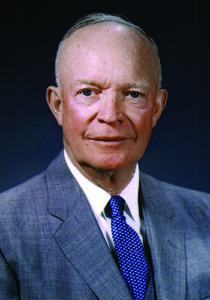
Dwight David Eisenhower. Photo courtesy of White House – Eisenhower Presidential Library
No one really knows what advice is important and what to discard. Until it’s too late. Dwight David Eisenhower has been scorned by most historians who rate both World War II’s commanders and U.S. Presidents. All he did was quietly coach more flamboyant generals like George Patton, Douglas MacArthur, Omar Bradley and Bernard Law Montgomery into a team that won the big war. Then Ike got the interstate highway system up and running while maintaining eight years of peace and prosperity.
Eisenhower also gave Baby Boomers great advice. He’s the guy who famously warned America to “beware the military industrial complex.” He also explained the great mystery of man’s plans and God’s laughter.
“When I was a small boy in Kansas, a friend of mine and I went fishing and, as we sat there in the warmth of the summer afternoon on a Smoky Hill River bank, we talked about what we wanted to do when we grew up. I told him that I wanted to be a real major league baseball player, a genuine professional like Honas Wagner. My friend said that he’d like to be President of the United States. Neither of us got our wish.”
Eisenhower played center field on the Abilene High School baseball team, entered West Point and played JV baseball with Omar Bradley. Many years later, after winning battles, wars and elections, Ike wrote that “not making the baseball team at West Point was one of the greatest disappointments of my life, maybe my greatest.”
The best laid plans of mice and men often go astray, not because they are bad plans. More likely it is because God, aka “The Unseen Hand,” is what American Indians from the Urubamba to the Gila valleys called the Great Trickster. Economist John Maynard Keynes famously wrote “The inevitable never happens. It is the unexpected always.” That observation is repeated over and over in his greatest work “The Economic Consequences of the Peace.” Ike read Keynes’ book, incidentally. So did Uncle Bill.
Sunscreen
As long as God is a trickster, advice remains as fool proof as roulette strategies. One of the most famous modern pieces of advice was itself a great trick. In the early days of the internet, five years before FactCheck.org (2003) and nine before PoliFact (2007), a commencement address to MIT graduates, supposedly by Kirk Vonnegut, went COVID-level viral. Vonnegut later told anyone who would listen that he had nothing to do with it and that he had never spoken at MIT. He also added that it was funny and intelligent and he would have been proud to have been its author.
The speech was actually written by Mary Schmich for the Chicago Tribune. In it she said that the best advice she has for the young was “to wear sunscreen.” Outside of that, she wrote “Advice is a form of nostalgia. Dispensing it is a way of fishing the past from the disposal, wiping it off, painting over the ugly parts and recycling it for more than it’s worth. … But trust me on the sunscreen.”
Many dreams
My personal plans for adult life disposed of many dreams. Otherwise, I would have been a cowboy or a baseball player. I spent a year managing a horse ranch but never felt comfortable riding a rambunctious horse. Nearsightedness destroyed my ability to hit a curveball.
I found shelter from the storms of life in perpetual high school by writing, mostly about food. I learned to cook after my mother responded to my criticism of her cooking with the suggestion that I cook my own meals in the future. I was 10, but my grandmother had taught me a lot, including “Don’t ever tell your mother that I let you use the sharp knives.”
I even wrote my college thesis on South Indian cuisine differing between villages just a few miles apart. But food was just a great hobby until Connie Wimer asked me to write about it for this magazine’s predecessor in the 1980s. And before I met the love of my life in 1996 at a travel writers convention. She was both a chef and comedian, making her a perfect companion with whom to navigate a perverse world. We met after her airline lost her luggage and my hotel van service stood me up at the Spokane airport.
As Vonnegut wrote: “Abrupt changes in travel plans are dancing lessons from God.” We tangoed through life together after that until she died. The lesson, I think, is to never let anger interfere with opportunities.
Food writing came naturally to a guy who believed in the futility of anger, and in taking anything too seriously. As Larry McMurtry said: “Medicine is the softest science, and nutrition is its melted butter. Whatever is gospel today will be anathema in ten years.”
I lived through nutritional movements that demonized, in succession: pork, red meat, sugar, game, wine, hard liquor, raw food and all things even remotely connected to animal life. They all came and went. The only enduring food wisdom I gleaned came from the Sakyamuni Buddha 2000 years ago: “All things in moderation are good. All things in excess are bad.”
Nutritional gospel?
All the rest turned out to be noise, like politics. The greatest unnecessary health crisis of my lifetime was laid on the nutritional gospel that fats were evil but carbs were good and thus needed to be made artificially cheap. After the American Medical Association narrowly voted to recommend a diet low in fats and high in carbs in the early 1980s, political leaders initiated huge subsidies to increase new, highly processed carbs like high fructose corn syrup (HFCS). They pretty much replaced real sugar in all soft drinks, ketchups and jams by the early 1980s.
The problem was that HFCS doesn’t possess a satiety factor like real sugar does. People could drink drastically more bottles of Coke a day. Soft drinks went from being sold in six-ounce glass bottles to two-liter plastic bottles.
As God laughed, that made America more obese and more diabetic. The rates of both those issues began rising the year after HFCS replaced real sugar in soft drinks. Today gospels and anathemas have turned upside down again. Proteins are the new gospel and fats have gone from all bad to half good. America’s new food pyramid scorns the carbs that were once pushed down American throats like force fed geese.
Find shelter
What the world needs now is levity. Try turning off the mainstream noise and find shelter in “Inside Edition.” While summing up a day’s news in 30 minutes, it provides survival lessons in a world that God finds hilarious.
Clothes might not make the man or woman but they definitely make the news.
Cute animals are just as important as anything that any politician did.
If you want people to watch something, just tell them that what they “are about to see may be graphic and disturbing.”
No news should take more than 30 seconds to tell.
Don’t bother with “expert opinions.” Viewers like to make up their own minds and to not be lectured by someone who thinks he is smarter than they are.
All stories can be told in three minutes; most stories in less than one; the best in 30 seconds.
A tease creates anticipation and keeps viewers from leaving during commercials. Two teases are better. Three are best.
Beyond that, Ike dispensed additional wisdom worth repeating today. “The more baseball the better. It is a healthful sport and develops team play and initiative, plus an independent attitude.”
Independent attitudes are anathema at all the cool kids’ tables today. Politicians vote on strict party lines for insane ideas like defunding police, unlimited access to assault rifles, open borders, and protecting the industrial complex’s right to poison our water with a chemical that only kills — mostly syphilis and weeds.
But trust me on the nutrition. ♦