
Paradise lost — The rich black dirt of Iowa
9/2/2026From the human point of view, dirt is the ultimate outsider. We try to keep it out of sight, out of mind and outdoors. We kick it off our shoes, spit on it and degrade it linguistically with dirty jokes, dirty minds, dirty secrets and dirty truths.
In the end, everything comes from it and everything returns to it. It is first on Aristotle’s list of the “Big Four” elements of life, ahead of air, fire and water. Yet somehow, no one worries that it is disappearing.
When agriculture was the “new technology,” 98% of the population worked the land to support the small ruling classes who somehow controlled its distribution and its bounty. Today, less than 1% of the U.S. population works the land. While the world population keeps growing, the amount of productive land that is farmed has been in steady decline since the 1970s.
The Mississippi River pushes a dump truck load of Midwest topsoil to the Caribbean’s Dead Zone 86,400 times a day. That silt would make farms more productive, but, ironically, it kills sea life. Each year, 24 billion tons of soil are lost to water, fire and air. That adds up to 17 tons per person. Yet that is too little to interest the hearts or minds of politicians, or much of anyone else. Just visit your local supermarket and be reassured that this is no crisis.
Dirt’s more virtuous sister is called soil. She gets more respect. While dirt is dead to us, soil is composed of a living, organized ecosystem made of minerals, organic matter, water, air and microorganisms that sustain plant life. Soil is the skin of planet Earth, but much thinner in proportion. Unlike our skin, soil acts as a destructive blanket that breaks down rock to form sand, silt and clay, which together become the best soil at a 40-40-20 ratio.
Darwin’s other obsession
Soil is so essential to life that Charles Darwin spent the last 23 years of his life exclusively studying worms. He dug in his fields, excavated ancient ruins and weighed their casings until he concluded that worms created the soil that nourished all life on Earth. While dissecting worm gizzards, Darwin found grains of rock and sand, concluding that worms were the key player in soil formation — the original plows.
“It may be doubted that there are any other animals who played such an important a role in the history of the world,” he concluded. Belittled by colleagues, some of whom thought he was senile, Darwin persisted, believing that those lowly creatures of the dirt were the key to all life.
Nine months ago, my publisher asked if I would be interested in writing a story about soil. Thinking of Darwin’s old age, I jumped at the offer. Soil has fascinated, absorbed and confused me since I was old enough to listen to my grandparents’ stories of Iowa farm life in the 1930s, the decade that changed America more than any other.
While watching my maternal grandmother inject herself with insulin, she would regale me with tales of darkness at noon, sand dunes burying horses and dust storms that shot holes in barns. That was just before half her family moved to the West Coast, her oldest daughter on the back of a motorcycle.
I grew up afraid of the candy that Grandma blamed for her insulin shots, but not so much of the dusty old dust. Out of sight was out of mind for me. Until I spent 1967 and 1968 in India, allegedly studying. But it was the 1960s in India, too, and my college was on strike most of the entire time.
My university allowed me to compensate with independent study, and with the aid of an Indian Railways pass, I visited all states and all neighboring countries. A good friend at the Rockefeller Foundation talked me into accompanying him to Punjab. He was checking out an agronomist who was developing a new dwarf wheat plant. I was drawn to the romantic ruins of Mohenjo Daro.
My friend made a lifelong connection to Norman Borlaug while I choked on dust not unlike my grandparents’ horror stories. And I was less than 100 miles west of the farms that spawned the Green Revolution. I learned that disappointment is part of all romance, and that even the fertile Indus Valley, one of the “five cradles of civilization” I had learned about, was prey to erosion’s insatiable hunger.
While winding my way back to the Midwest from India, I visited Baghdad. Nourished by romantic storytellers of ancient history, my plan was to see the original Garden of Eden. Teachers, preachers and airline promotions told me it was supposed to be where Baghdad is and the Hanging Gardens of Babylon used to be — between the Tigris and Euphrates rivers. My plan was that of a food-obsessed romantic — to eat bread made from the “mother wheat.”
Instead, I found another desert, only slightly more habitable than Mohenjo Daro. Babylon’s wondrous hanging gardens were abandoned when they became too difficult to water. Thousands of years later, the piles of silt that clog their irrigation ditches were 30 feet high. The prophet Abraham’s hometown of Ur was coastal in his day, but in 1968 it sat 150 miles inland, the result of silt pouring out of the Euphrates into the sea.
And wheat no longer grew there. Barley was the region’s cash crop; it’s harder to kill than wheat and other grains. I ate “paqota” and “habya,” porridges of simmered barley. Wheat was imported to Baghdad. I moved on to less disappointing romances but could never stop wondering what had happened to the Garden of Eden.
Bringing it back home
Iowa was a source of pride when I traveled. Its legendary fertility was well known in India, even before Borlaug came there to feed the world. John Kennedy had famously confided to Time magazine’s Hugh Sidey, an Iowan, that “Your rich black dirt looks good enough to eat.”
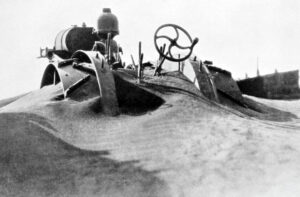
Wind erosion in the Dust Bowl lasted for years in the 1930s, moving dramatic amounts of valuable soil — enough to practically bury this farm machine. Photo by NOAA, Dept. of Commerce.
Before he died in 1975, my grandfather asked me to drive him back to his former farm in Clay County. When we got there, he asked, “Where did my orchards go?” And his vineyards, gardens and hayfields? Like most of Iowa after World War II, his farm had been plowed over while his grasslands, orchards and vineyards were destroyed to the service of just two row crops — corn and soybeans.
Historically, grasslands, like Iowa before Europeans, have been essential to agriculture because they cover the most fertile soils. Before they were exterminated, millions of buffalo grazed there and fertilized the soil with their dung.
Because of technological advances in plant genetics and chemical fertilization, five crops — wheat, rice, corn, soybeans and barley — dominate the world. Once rare, they now cover nearly 2 million square miles, more land than covers all the forests in America, including Alaska and Hawaii.
Mohenjo Daro and the Garden of Eden are not exceptional stories. Their rises and falls share a common denominator with most great agricultural civilizations, including China’s Loess Plateau, Madagascar’s Highlands, Equatorial Africa, the Sahel, Congo, Amazon Basin, and the pampas and Cerrado of South America.
Decades after not eating wheat in Baghdad, I visited the Argentine pampas expecting to eat grass-fed beef. Sadly, that, too, is a thing of the past. I discovered that the pampas of Argentina and Brazil have been plowed over and converted to corn and soybean farming and that the cattle mostly eat grains in confinements, just as in the U.S.
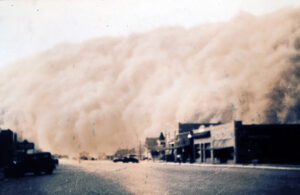
Dust bowl. Photo by jellie123 on Flickr
That same old story goes like this, laid out by David Montgomery in “Dirt: The Erosion of Civilizations.” In fertile valleys, farming allows populations to grow to the point that agriculture is extended into the forests, grasslands and hillsides. There, it is susceptible to erosion at faster rates than it can be replenished. The land fails to support the population. The population moves on to the next place, colony or civilization.
In the 465 years between the First Republic and Julius Caesar, it took 10 times as much Italian land to feed the same number of people. Centuries of aggressive agriculture, overgrazing and demand for timber led to soil erosion, permanently removing some areas from agricultural use. That drove Roman conquest — to rape the fields of the far-flung empire and subjugate slaves to feed the growing population.
Medieval Europe ran out of fertile land quicker than Rome and moved on to conquest of colonies to support its population. Serfs were the new slaves, but not much else changed. By the 15th century, the Roman Catholic Church had overtaken nobility as the largest landowner class in Europe. Many historians now believe the Reformation of 1517 was fueled by the church’s poor stewardship of the land more than by the corrupt sale of indulgences.
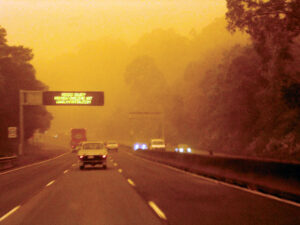
Dust bowl. Photo by daflee on Flickr
America was designed for raping the land and then “drifting along” in Woody Guthrie’s words. We called it Manifest Destiny. As early as 1902, the U.S. Geological Society warned that the Great Plains were “fatally vulnerable” to erosion when plowed. Manifest Destiny remained in denial, settling the plains and turning its soil over for decades with bigger plows than ever before. By 1909, the annual loss of topsoil in the Great Plains equaled twice the amount removed to build the Panama Canal. Eleven million acres were abandoned because of soil erosion.
Then, all hell broke loose. The first major wind storm hit South Dakota on Armistice Day 1933, a God-forsaken reminder that death is inescapable. Many farms lost all their topsoil on that single day. The following day, the sky was completely dark at noon. The atmosphere measured three parts dust to one part air. That was just the beginning.
On May 9, 1934, winds tore across Montana, Wyoming and both Dakotas, moving east at 100 miles per hour. On May 10, 4 pounds of Great Plains’ dust fell on each resident of Chicago. On May 11, dust fell over New York City and Washington, D.C.
By the end of that year, the National Resources Board announced that wind had destroyed farmland the size of Virginia. In spring 1935, right after fields were plowed, winds blew across the plains from Texas to Nebraska, embedding grains of sand in fence posts and rising 10,000 feet, blotting out all light and piling Sahara-class dunes over railroad tracks, roads and horses.
By the end of that decade, 3 million people had moved out of the Great Plains, mostly to labor-hungry California. The cotton fields of the Southeast also lost 6 inches of topsoil in that decade, driving workers north to Chicago and Detroit, along with their blues and soul food. Dixie’s cotton fields mostly moved to West Texas.
The corn and beans dilemma
Iowa lost 200,000 acres of farmland to 1935’s dust storm, eroded beyond redemption and abandoned. A quarter of the soil was lost over a billion acres of mid-America. A government research station in Missouri, near the Iowa border, reported that soil was lost in cornfields at 300 times the rate in alfalfa fields. Another research station in Oklahoma reported that soil eroded in cotton fields 10,000 times more than over grasslands. No wonder my grandfather rued the loss of his hayfields.
Somehow, Iowa survived the Dust Bowl years and still produces bumper crops of corn and soy that are the envy of all other farm states. But are we deluded? Iowa today has lost one-third of its topsoil in 150 years. I sought out sage opinions, asking the Iowa State University media office for contacts with a biologist and a geologist. My thinking was the latter thinks in terms of millennia while the former is more concerned with just the next planting and harvesting season. They told me that there was one guy who thought in both disciplines.
Richard Cruse is a professor of agronomy at Iowa State University and director of the Iowa Water Center. He leads the Agricultural Conservation Planning Framework National Hub and co-leads the Daily Erosion Project. His program involves modeling research in soil erosion, soil management and soil physical properties. We asked him for the last words in this story.
Is Iowa another Garden of Eden, a paradise of fertility lost to desert?
“What’s your timeline? Biology is limited not by averages but by extremes. As long as climate changes can be measured in fractions of a degree a year, we will see (devastation) as a ‘not in my life cycle’ problem.
“Politics and policies are more devastating than climate in the short term. Certainly, soil degradation is a player in terms of food production capacity. Iowa has lost a third of its top soil since the 1870s. Before then, it wasn’t significant agriculturally; it was a swamp that had to be drained and tiled.”
How much tile is there under Iowa’s fields of grain?
“No one knows. There are many, many miles of it but no one kept records in the early days. The worry today is that most Iowa agriculture is row crop ag. That’s a very erosive system, especially because it’s mostly corn and beans, and those are annual crops. It would be better if we planted perennials. Annuals are planted in spring, harvested in fall and are barren the rest of the year — susceptible to rain, wind and pestilence. Raindrops falling on empty fields are the start of the process of destruction, if the ground isn’t able to absorb them.”
Is there an upside?

Rick Cruse
“We aren’t doing as much damage to the soil now as we were in the 20th century. We don’t till as deeply or destructively. We know now that crop residue retards erosion, so we harvest with that in mind. Corn stalks protect the soil after harvest. Chemical weed control is not as bad as shovel weed control. Slope farming is worse for erosion than flatland farming, and Iowa is a relatively flat state.”
Nonfarming Iowans worry about the chemicals, particularly the glyphosate in Round-up, which is a powerful poison.
“Glyphosate in the soil doesn’t worry me too much because it is short-lived. Soil is very adaptable to chemicals. We don’t know, though, how it breaks down. Forever chemicals are more worrisome. All the chemicals interact so complexly that I worry. I talk to people in D.C. (USDA) who tell me Iowa soil has a higher chemical load than any other state. What happens with that is something we don’t know.”
Is my mind playing tricks on me, or is JFK’s rich black dirt not as black as I remember it as a child?
“It’s not as black.” ♦