
Hunting down Greater Des Moines’ ultimate Italian dish
8/5/2026Each August, CITYVIEW asks its readers to find the ultimate food of a specific category. This year, we are seeking the supreme Italian dish of greater Des Moines. Since we have searched several times for the ultimate pizza, we are not including those amongst this year’s choices.
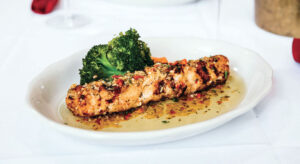
The Latin King’s chicken spiedini has been the restaurant’s best seller for decades.
Italian cuisine is a complex of contradictions and extremes. In the 1950s to 1970s, southern Italy birthed the “Mediterranean Diet” that was widely credited as the healthiest way to eat, especially for longevity. In the third millennium, the same part of Italy became the peninsula’s biggest consumer of junk food and carrier of obesity.
Italians credit their most famous food with superhuman properties. Sophia Loren, possibly the most voluptuous incarnation of 20th century cinema sirens, famously proclaimed, “Everything you see I owe to pasta.” Her great friend Federico Fellini said, “Life is a combination of magic and pasta.”
Celebrity chef Wolfgang Puck saw an opposite quality: “Italian food is all about ingredients and it’s not fussy and it’s not fancy.”
TV star restaurateur Lidia Bastianich also noted that the beauty of Italian dishes is their simplicity: “A box of spaghetti can take seven minutes to cook, and you can make a sauce at that time with perhaps garlic, olive oil and zucchini. Then you’ve got yourself a complete meal. The whole thing shouldn’t take more than half an hour.”
On the other hand, historical novelist Crystal King writes about the extreme decadence of dining in Ancient Rome. Her “Feast of Sorrows” celebrates infamous epicurean Marcus Gavius Apicius and his personal chef Thrasius. Apicius’ own books have been lost since the Dark Age, but King’s remind us of Italian food’s extremes.
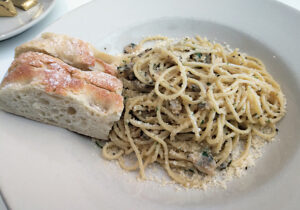
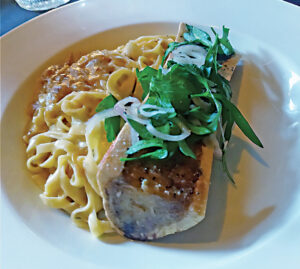
Linguini and clam sauce at Lucca.
Apicius took foie gras far beyond force feeding geese and ducks. He starved his piglets, then let them gorge on dried figs. Next, he would get them drunk on as much wine as they could drink, causing the figs to expand in their stomachs and ferment, thus killing the pigs. They were promptly slaughtered and served to Rome’s elite.
Figpeckers are little garden warblers that devour figs. They were eaten by Romans like the epicurean French eat ortolans — cooked in a sauce and devoured whole, bones and all. Apicius used figpeckers as one of the layers in a dish that some historians think might be the precursor of lasagna.
Few, if any, animals were taboo amidst the epicurean lust of ancient Rome. Apicius believed that entrées of peacock occupied the first rank, provided they be dressed in such a manner that the hard and tough parts be tender. Today, duck tongues are still eaten in Europe as a delicacy, but in ancient Rome, all manner of bird tongues were loved by those who could afford them. In his “Natural History,” Pliny tells us, “Apicius established the view that the flamingo’s tongue has an especially fine flavor.”
The U.S. declared lungs unfit for human consumption in 1971, but ancient Romans loved to eat them. An Apicius recipe calls for soaking them in milk, straining, breaking two eggs inside them, plus a little salt, and mixing in a spoonful of honey before tying off, boiling and slicing.
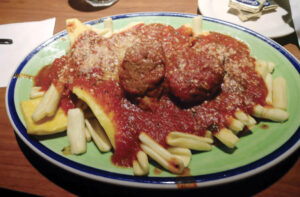
Half and half (cavatelli and ravioli) with meatballs at Noah’s Ark.
The dormouse isn’t eaten much today, but ancient Romans stuffed, fried and ate them whole, bones and all. Apicius stored his dormice in a special terracotta pot with holes and little shelves inside, like today’s live lobster tanks.
Private parts of female pigs are usually taboo today. In ancient Rome’s orgies, it was a common to eat the vulva of a sow either after it miscarried or had given birth. Womb was considered best eaten when it was sterile, so sows were spayed for that purpose. Apicius tells us that the full udder, with the paps still on, should be stuffed with spiced, ground sea-urchin, sewn up and cooked, then served with a mustard sauce.
Vedius Pollio was the son of a freed slave who became the most notorious of slaveowners. His cruelty included a habit of throwing misbehaving slaves alive into a pool of moray eels that would rip them to pieces in a matter of minutes. He believed that eels tasted best after feeding on human meat.
That was then. As for now, ideas of an ultimate Italian meal steer clear of Roman extremes. In fact, as noted by Puck and Bastianich, ideal Italian dishes find beauty in simplicity. We asked several AI platforms what people today think of as the greatest Italian dish, worldwide. Pastas were the most frequent answers. They are sumptuously simple, but simplicity in Italian dishes comes with complex nuances.
All pasta are simply flour and water, with eggs and salt optional. While a popular legend credits Marco Polo with bringing pasta from China in the 13th century, historical records prove pasta was being made in Italy long before his travels. Archaeological evidence from 400 BC shows Etruscans making early pasta dishes.
In the 9th century, Arab traders introduced dried durum wheat noodles to Sicily. Sicily’s dry climate made it an ideal hub for producing this non-perishable food, which quickly spread to mainland Italy. By the Middle Ages, Italians had refined dried dough, popularizing it across the peninsula. During the Renaissance, regional variations of pasta exploded, with Naples and Rome creating their own distinct shapes and pairing them with diverse sauces.
Italian cuisine is dynamic. Consider that the food that is most identified as Italian only came to Italy in 1544 and was hardly eaten until the mid 1800s. Francisco de Orozco, a captain in Hernán Cortés’ Conquistador army, was the first European to eat tomatoes when he marched into Mexico’s Valley of Oaxaca.
Because they were a member of the mostly toxic nightshade family, tomatoes were barely eaten in Europe, or Colonial America until the 19th century. Even the adventurous Ben Franklin thought they were deadly. Today, they are the most visible component in most popular Italian dishes, especially those of southern Italy from where most of Des Moines’ Italians emigrated.
A delve into the five dishes that were most frequently mentioned in media searches among the greatest Italian food inventions demonstrates this complex simplicity.
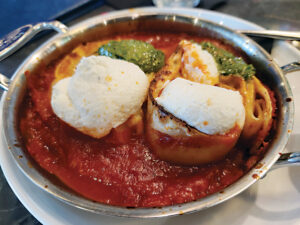
Prime and Providence includes spinach in their lasagnaolo.
Lasagna
Lasagna transcends Italian stereotyping. In Italian American households in Des Moines, it is as inevitably a part of Thanksgiving dinners as turkey. The earliest ancestor of the dish was “lasagna patina,” an ancient Roman casserole made by layering thin sheets of dough with meat, fish and, in Apicius’ case, figpeckers.
Modern versions were refined during the Middle Ages in Naples. Neapolitan “lasagne di carnevale” was a lavish feast dish made with local sausage, fried meatballs, hard-boiled eggs and ricotta cheese. The first recorded recipe of this version dates to the 14th century.
The world-famous “lasagne al forno” — baked with traditional ragù, Béchamel sauce and Parmigiano-Reggiano cheese — was perfected in Emilia-Romagna, where pasta sheets are often made green with spinach and where Parmigiano-Reggiano cheese originated, as well as tortellini, tagliatelle, prosciutto, balsamic vinegar and mortadella.
Today that familiar layered dish is made with a thick ragù and Bechamel sauce, ricotta or mozzarella cheese, typically flavored with wine, onion and oregano. In all cases, the lasagna is oven-baked, or “al forno.”
Many Italian regions have their own signature style of lasagna, from Le Marche with sliced truffles to Molise, where it is served in broth. In Sardinia, lasagna is made with wafer-thin flat bread, which is also known as “carta da musica” (sheet music) due to its sonorous crunch.
Des Moines restaurants serve various types of lasagna. Noah’s Ark doesn’t even use sheets of pasta that we also call lasagna. It substitutes rigatoni and resembles pasta chena. Owner James Lacona says it’s one of his most popular dishes after pizza. Few places use spinach, let alone spinach pasta. Prime & Providence does offer a lasagnaolo side dish, with spinach.
Risotto
Risotto originated in Northern Italy during the Middle Ages, after Arab traders introduced rice to Sicily. Later, the humid climate of the Po Valley provided ideal growing conditions and, by the 15th century, rice became a staple in Lombardy, Piedmont and Veneto. The modern slow-cooked method evolved from there.
The most famous legend centers around “risotto alla Milanese.” In 1574, Valerio of Flanders, a glassmaking apprentice working on the Duomo in Milan, became known for using saffron to tint his stained glass. As a prank at his master’s wedding, he added a large amount of the yellow spice to a pot of rice, inadvertently creating the golden, saffron-infused dish.
The first cookbook recipe for risotto is from 1809, “riso in padella.” The rice was sauteed in butter; sausage, onions and saffron were gradually absorbed in chicken broth. As Puck noted, Italian dishes are about the ingredients. While arborio, carnaroli and vialone nano rices rule the risotto realm, chefs have used red rice, black rice and other short grain varieties to create risotto dishes. Cooking broths prefer poultry stocks but all manners are used including red and white wines.
Mushrooms are a preferred enhancer and truffles are considered the ultimate mushroom, especially in the northern provinces of risotto’s fame and founding. All manner of mushrooms are used. Combinations as varied as duck, game, pumpkin, sausage, snails, squid ink, seafood and almost everything else are used in this classic dish.
Radicchio risotto is the most complicated enhancer of risotto. In the Veneto, radicchio is the preferred ingredient for the dish. The best radicchio, which is a chicory, comes from Veneto where specific growing areas hold the prestigious IGP (Protected Geographical Indication) status. The most highly prized varieties are natively named after, and exclusively grown in their exact towns of origin.
In his book “Steak,” food writer Mark Schatzker writes about how residents of the Veneto can identify exactly where different radicchios were grown. Named after a small fishing port in Venice’s lagoon, radicchio di Chioggia refers to the chicory of Precoce and Tardivo varieties, grown within the provinces of Venice, Padua and Rovigo. Rosa di Gorizia is a variety originating from Gorizia and Collio area in Friuli Venezia-Giulia. It looks similar to a rosebud that’s just about to open, hence the name “Gorizia rose.”
Created in the 17th century by crossing radicchio di Treviso and escarole, the variegated radicchio di Castelfranco Veneto is a type of chicory grown within the provinces of Treviso, Padua and Venice. Thanks to its peculiar shape and blanched yellow leaves covered in red flecks, it is nicknamed “orchid lettuce” or “winter rose.”
Risotto is such a popular dish that a whole festival is organized in its honor. The Festival Nazionale del Risotto takes place in Biella, Italy, every year in the Piedmont.
This marrow bone from Aposto represents a half order of osso buco.
Osso buco
The story of osso buco begins in 19th century Lombardy, the prosperous region surrounding Milan. The name literally translates to “bone with a hole,” a direct and humble reference to the cross-cut veal shank and the prized marrow found within it. Historically, diners use a special, slender marrow spoon to scoop out every last morsel.
The original preparation was known as “in bianco,” meaning without tomatoes. Early recipes relied on a restrained palette of ingredients: veal shank, butter, onions, white wine and broth. The resulting sauce was pale and delicate, emphasizing the natural flavor of the meat rather than masking it with acidity or sweetness.
Later interpretations introduced tomatoes, sometimes fresh, sometimes in small quantities, to create a richer sauce with more umami. While that version has become common in restaurants, historians generally consider the tomato-free preparation the truest expression of the Milanese tradition.
In Des Moines today, veal is optional. Ruth’s Chris makes a veal osso buco ravioli appetizer. The dish is more often made with pork (Anna Dolce), beef or lamb (Aposto, HoQ). One element, however, has remained constant: gremolata. This simple garnish is made from finely chopped parsley, garlic and lemon zest. Aposto adds mint from their garden. Sprinkled over the finished dish just before serving, gremolata cuts through the richness with bright, aromatic freshness. The citrus oils from the lemon zest awaken the palate, while the parsley adds herbaceous lift and the garlic contributes a sharp, savory edge.
Taken from the lower leg of whatever animal, the shank is rich in connective tissue, collagen and marrow. In its raw state, they make the meat tough. But when cooked slowly in liquid, the collagen gradually dissolves into gelatin. As this transformation occurs, the sauce thickens naturally and the meat becomes exceptionally tender. What begins as a firm, sinewy cut evolves into a silky, almost spoon-soft texture. Magic.
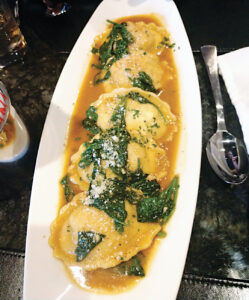
Lobster ravioli at Ruth’s Chris.
Ravioli
The word ravioli comes from the old Italian word “riavvolgere,” which means “to wrap.” One of the first historical documents mentioning ravioli is a late 12th-century contract from Liguria. By the Renaissance, ravioli were a favorite at noble courts in Lombardy. Today, fillings differ heavily by region, with northern areas preferring rich meats and central regions like Tuscany leaning into fresh ricotta and spinach
Italian food historian Oretta Zanini De Vita writes in her “Encyclopedia of Pasta,” that ravioli began in high society but soon became a favorite of farmworkers.
Today they are the most popular Italian dumpling, or stuffed pasta. Like their cousins cavatelli and gnocchi, they are wrappers for more exotic foods. In Des Moines, Ruth’s Chris and Prime and Providence make versions stuffed with lobster.
Tiramisu
Tiramisu originated in northeastern Italy, with the Veneto and Friuli-Venezia Giulia regions both claiming its invention. The most widely accepted origin story points to the restaurant Le Beccherie in the 1960s. Owner Alba Campeol and pastry chef Roberto Linguanotto created the dessert by modifying “sbatudin” (a whipped mixture of egg yolk and sugar) by adding coffee, mascarpone cheese and ladyfingers. The name “tiramisù” was coined there to describe its restorative energy.
A popular folk legend claims the dish was born in the mid-19th century in the brothels of Treviso. The madams of those establishments allegedly served the high-calorie, highly caffeinated dessert to male patrons to provide an energy boost and an aphrodisiac effect before they returned to their wives. The Italian name “tirami sù” translates literally to “pick me up.”
Those are just five dishes, each with nearly infinite variations. Now it’s up to readers to select their idea about where to find the ultimate Italian dish of the metro. n