
Fireworks, family and farm memories
6/3/2026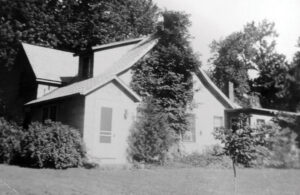
Kneen family farmhouse circa 1950s
Fireworks were an annual point of contention on our three-generation family farm. Grandma was agin’em. Grandpa was for’em, as were the four grandkids. Mom was Switzerland on this black powder issue. It was a standoff. Grandma’s vote weighed heavily against all others, but the deciding factor was beyond question: This was all in honor of the celebration of our nation’s independence, our freedom from an oppressive monarchy. Since all the explosive, ear-ringing pyrotechnic extravaganza was to honor our country, Grandma begrudgingly became an abstaining member of the voting forum. Fireworks did happen, albeit on a small scale, on that little farmstead ‘tween Winfield and Mount Union, Iowa.
Shews, games, sports, guns, bells, bonfires and illuminations
Before recalling our family’s firecracker adventures, let us take a quick dive into America’s history. The Continental Congress voted in favor of independence on July 2, 1776, and two days later the delegates from the 13 colonies adopted the Declaration of Independence. John Adams’ letter to his wife, Abigail, proclaimed, “[This day] ought to be solemnized with Pomp and Parade, with Shews, Games, Sports, Guns, Bells, Bonfires and Illuminations from one End of this Continent to the other from this Time forward forever more.” The tradition of setting off fireworks on the Fourth of July began in Philadelphia on July 4, 1777, during the first organized celebration of Independence Day. Ships’ cannons fired a 13-gun salute to honor the 13 colonies. Since then, America has released a barrage of pyrotechnic spectacles, usually the culmination of parades, celebrations, history, barbecues, ball games and more.
It should be noted that America did not invent the use of fireworks for such celebratory patriotism. This was a longstanding tradition in European countries and beyond. We simply “Americanized” the centuries-old tradition. Our forefathers loved the pageantry displayed in shucking the yoke of tyranny.
Across the border
Fast forward to the 1960s southeast Iowa Kneen family farm. Almost all forms of fireworks had been banned in Iowa since 1931, when a young boy dropped a sparkler into a fireworks display, setting off a conflagration that destroyed 20 buildings in downtown Spencer. The law did not stop Iowans from driving to Missouri, where fireworks could be purchased. That, plus cheap cigarettes and cheap gasoline, often had Iowans driving across the border to save a few bucks.
Every highway traversing the border into the Show Me State had at least one fireworks stand waiting on t’other side, as cash registers rang up a steady inrush of Iowa dollars. Iowa law enforcement seemingly looked the other way, although hauling a load of forbidden booty tickled our innards with a bootlegger’s rush. Even in recent years, Iowa-based family gatherings around July Fourth involved fireworks, especially with The Timber’s pond providing a reflective enhancement of the airborne displays.
Grandpa was our mule, since he was the only “for’em” voter with a driver’s license. As we were ready to depart for another clandestine trip for ill-gotten Missouri explosive plunder, Grandma fired a final judgmental dig.
“Well,” she would sniff. “If you’re going to get those firecrackers, why don’t I save you a trip. Just give me your money and I’ll burn it now!”
We were not phased. We burst through her condemnation, which still hung in the air, and excitedly clambered into the car. After a mile and a half of gravel road, we hit the county hardtop and headed west to Highway 218, then south. Just past Donnellson, we took the Iowa Highway 394 cutoff through Argyle before it crossed the Des Moines River into Missouri.
The final passage before reaching our mecca of explosive mayhem was a cantilever truss bridge. This 1937-era span ushered us into St. Francisville, our black powder paradise. After traversing the 763-foot length to the Missouri end of the bridge, a restrictive barrier arm blocked our progress. Had the cops caught us? Who had ratted us out — Grandma?
No, it was the toll booth operator, a crusty codger who extended his gnarly hand for the two bits required to complete the journey across his bridge. Our held breath released. We made it. The old Pontiac rumbled into Missouri and we were greeted by a bevy of seductive banners promising Iowans a mind-boggling variety of ways to exchange cash for things literally designed to go up in smoke.
Grandpa pulled into one of the roadside vendors. We stepped inside the tent, and a bedazzling array of captivating graphics beckoned. Shelves upon shelves, stacked to the top of the tent. Black Cats, spinners, cherry bombs, bottle rockets, Roman candles, fountains, whizzers and more — they were all there, waiting for our discerning evaluation before we dipped into the meager depths of our pocket cash.
The disproportioned graphics on the fireworks packaging showed Lilliputian humanoids launching massive fireworks. The Black Cat image was especially foreboding, a source of future nightmares.
We walked past gigantic Roman candles and rockets, far out of our price range. We could dream, though. Grandpa escorted us, as he was the one who had to make the final purchases. Exiting with the bounce of well-armed explosive artists, we raced back to the car.
The return to the farm was uneventful, albeit with a gut-deep twinge of looking over our shoulders for police to stop and arrest us, or at least confiscate our illegal contraband. We continued to assess and reassess our carefully plotted purchases. We discussed how we would ignite them and imagined how they would perform.
The acrid smell of spent black powder
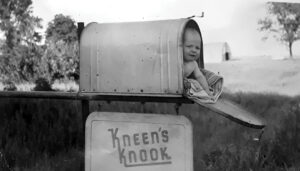
The author’s first visit to his grandparents’ farm. They claimed his mother didn’t want to travel in the early 1950s with a baby, so shipped him via rural free delivery. The author claims being too young to remember, but had a feeling that fireworks would be in his future.
We arrived home just before suppertime. Grandma’s reception was silent and cold, body language that shouted her thoughts about our recent acquisitions. We were Christmas Eve-fidgety, knowing that after supper we would be trying some of our newfound wonders.
Our meal was a rushed affair, but the cleanup process remained the same. Grandma’s icy stare indicated no tolerance for skipping out on our duties of post-meal cleanup. Tasks completed, we dashed through the sun porch, grabbed our treasures and headed outside.
Grandpa was already comfortably ensconced in his classic tubular steel cantilever lawn chair. He was not required to partake in any of the post-meal chores. He casually rocked a bit in the giving tension of the chair, with perhaps a glint of expectation of what was to come. A spark of boyhood joy still flickered inside his weathered body.
We carefully displayed our modest assortment of fireworks: sparklers, Black Cats, bottle rockets, spinners and whizzers. Our impatience negated waiting until dark. We needed the adrenaline rush from explosions, crackles, pops and bursts of sound. The acrid smell of spent black powder was an intoxicating elixir.
The first order of business was to maximize the expenditure of resources. In other words, we wanted the joy of our own bombs bursting in air to last as long as possible. Task one was to take the packs of Black Cats, all braided together, and separate them into individual firecrackers. The vendor wanted buyers to light an entire pack and experience the series of explosions as the fuses sequentially lit so they would purchase vast quantities of the firecracker. We felt that was a terrible waste.
An entire pack of Black Cats, blown to smithereens, in less than 10 seconds. Bombastic sacrilege.
The Lord of Ignition
Grandpa surveyed the situation from his garden throne, helping rein in any overly enthusiastic ignitions of fireworks. He was the official Lord of Ignition, as he had a lighter. In the early days on the farm, he smoked cigarettes, often lighting firecrackers from them. He later gave cigarettes up for his pipe, and the cherry smoke-scented olfactory memory remains cherished. He would light the punks for us, those ubiquitous pressed sawdust wands. Once lit, punks would glow with a fuse-igniting ember, needing occasional encouragement to continue burning by blowing on them.
Grandpa also took snarky pleasure in tricking the farm cats. If a cat strayed near our activities, he would light a firecracker and toss it close to them. Their curiosity drew them close, and the subsequent explosion triggered an impressive feline leap into the air. When their feet touched earth again, I swear each cat gave Grandpa a glaring look. If that look were interpreted, the language would be much too coarse for our young ears.
The cats would make a quick dash away from the scene of their unpleasant experience, probably less one of their lives. Grandpa’s low-rumble belly laugh always followed this bit of chicanery, and the cats quickly learned to avoid any seeming edibles this elderly lord of the farm tossed their way.
Kid brother genius
We kids found imaginative applications for our fireworks. Some needed no additional thought, such as the whizzers and spinners. These had a special coolness factor as we carefully set them on the concrete slab — the general reference for a large area of concrete outside the back door where the car was parked for loading and unloading — and lit their fuses.
Upon ignition, the whizzers would quickly gain altitude, with their signature ascending musical crescendo. The spinners were a little less flashy, as they did not have the musical element of the whizzers, but they seemed to have a little more elevation in their upward, short-lived journey.
My brother and I created scenes with our toy soldiers, setting them up in military array, then setting firecracker charges close by. Successful explosions leveled all the soldiers; unsuccessful ones left some standing. A variation was to toss a firecracker in the midst of a military formation, striving for full platoon annihilation.
Please note that no military soldiers were injured during this juvenile male aggressive activity.
The bottle rockets were launched from 16-ounce Royal Crown pop bottles. I am sure that when we turned them into the grocery store for their 2-cent deposit, the grocer knew exactly why these bottles had blackened lips.
We discovered a more exciting way to use bottle rockets. Our farm had the usual array of old scrap metal, including pipes. After finding a couple of short lengths of 3/4-inch galvanized pipes, my brother and I would seal off one end, then quickly drop a lit rocket into its open end. This let us direct the rocket’s trajectory up and over the barn or soaring across the gravel road.
The next logical use was kid brother genius. We stood at least 20 paces from each other in a large area between the garage and the barn. That was our OK Corral and we would aim our rockets at each other, doing some fancy footwork to avoid being hit by each incoming salvo.
Yes, we undoubtedly heard “it’s all fun until someone gets their eye blown up.” That did not stop us, of course, and we laughed heartily with every launched missile.
Heartwarming glow of nostalgia
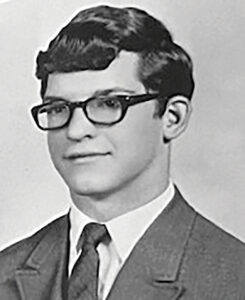 We survived those early years on the farm. The Fourth of July remains a special place in my heart. I truly appreciate the grand pyrotechnic displays that major events now produce.
My boyhood imagination undoubtedly conjured grand images that elevated our minuscule fireworks into a scale of glorious, sky-filling explosive spectacle, as daydreamed by a pyrotechnic Walter Mitty. Time softens the hard edges of memories’ realities and they become infused with the heartwarming glow of nostalgia.
If you were to ask my siblings to relate this same series of events, I promise their tales would be different. Enjoy this interpretation, and may it trigger memories of your own.
Since I told this tale first, mine is the standard by which all of our family’s July Fourth memories will be measured.
Pass the punk — I have got a whizzer to ignite. n
John Busbee grew up as a transplanted Army Brat into a farm kid on a century family farm in southeast Iowa. His youthful years in the country remain a vital part of his upbringing. He is the author of CITYVIEW’s Center Stage columns.