
Around the campfire
7/1/2026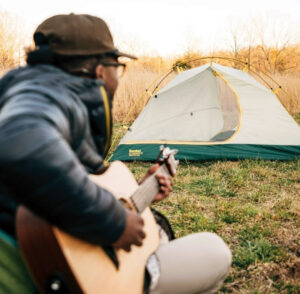
Eureka tents on display during a photoshoot with Stoked, guitar not included. Photo courtesy of Stoked
We dedicate pages of ink to highlight the many ways to spend your free time in central Iowa. From concerts and community events to art festivals and sports, we cover them all in an effort to help you make the most of every season. But what about those who enjoy getting away in the great outdoors without traveling too far? We have you covered there, too.
In and around the metro, and just beyond, both private and public camping options are available for those looking to escape the bright lights of the city and reconnect with nature. At Cutty’s Camping Resort, those bright lights might follow you in the form of its renowned Fourth of July celebration. At Pine Lake State Park, they may come from the night sky, where stars shine brighter away from the city’s light pollution. And before you head out, you will need the right gear.
We spoke with people representing each part of the camping experience to gather ideas on where to buy equipment, park your RV or pitch your tent.
Prepare yourself
Before exploring various campgrounds, make sure you are prepared with essentials such as coolers, boots, hammocks, fishing poles, tents, sleeping bags and bug spray. We spoke with Collin Smitherman, owner of Stoked, an adventure gear and clothing store in Des Moines’ East Village, about what campers should look for.
Smitherman grew up in Iowa and has spent plenty of time backpacking, tent camping and camper van camping. He pointed to a few essentials for any camping trip.
“I always bring a really nice water filter, just because you know how water is in Iowa these days. That’s number one. Some more comfort-related stuff. If I’m tent camping, I always bring a nice, lightweight chair,” Smitherman said.
For new campers, Smitherman often recommends starting with used gear.
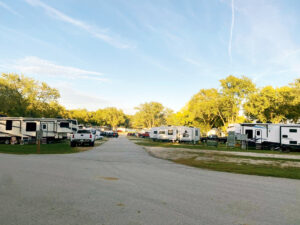
The camping scene at Cutty’s is almost exclusively campers, with the various styles of RVs, pop-ups and campers lining the streets. Photo courtesy of Cutty’s
“If you don’t do a lot of camping, or you maybe are just trying it out, I tell them to check out the used gear section first. I just try to meet them where they’re at on their needs. I never like to sell people on gear that they don’t need, because it’s just going to become waste. They’re not going to use it; it’ll just sit in their garage,” Smitherman said.
The store’s used section offers options for beginners and experienced campers alike, including tents, sleeping bags, cookware, clothing and footwear. With relatively few major camping gear suppliers in Iowa, it also provides an opportunity to buy and sell locally.
“It helps people get out there and get camping without all the barriers of being expensive. When people bring it in, it keeps that money local. We’re buying that gear from a local person, and then that money stays local, and then we sell it to a local that’s going to use it. I’d say 90% of the time, anything that we have in our used gear section is just people from Des Moines,” Smitherman said.
Private camping
Dick and Judy Cutler opened Cutty’s in 1968, and the camping club has undergone several transformations since then. At one point, the campground nearly went bankrupt. Members pooled their money and purchased all the shares to keep it operating. The move made Cutty’s member-owned in 1980, and members later adopted bylaws similar to those of a homeowners association.
Marketing Manager Steve Hamilton has been camping at Cutty’s since childhood and eventually became a member himself. Today, he works there, giving tours, explaining pricing, managing social media and more.
Those staying at Cutty’s tend to favor the glamour camping, or “glamping,” experience. The campground is filled with large campers that resemble small homes, some even featuring attached decks.
“The size of the campers, when we used to come, they were much smaller — pop-ups, tents. Now you see campers that have three air conditioners on the top of them and slide-outs and decks that pop out,” Hamilton said. “Just the evolution of the campers, going from your family station wagon to these monsters that come out with all the amenities, bathrooms, showers.”
Hamilton said campers once relied on compact bathrooms and multipurpose storage spaces.
“Now they have big enough bathrooms that a lot of people use their own bathrooms and showers rather than our shower houses,” he said.
Hamilton most often sees travel trailers and fifth-wheel campers, although preferences vary. Most visitors come to Cutty’s specifically rather than longer journeys to national parks.
Tent camping is allowed, but Hamilton says it is relatively uncommon. Many guests stay for extended periods, giving the campground a small-town atmosphere.
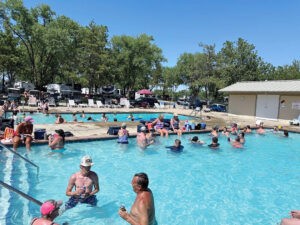
Cutty’s outdoor pool gets filled up with water and campers during the summer months. Photo courtesy of Cutty’s
“We have multigenerational members here. I came here with my grandparents. I remember it vividly. Now I have grandchildren. I want them to remember it. We’ve got many families that we’ve turned over their membership to. All of a sudden, the kids got it, and the grandkids. It’s interesting when I give someone a tour, and I hear that they used to come here as a child, and they’re much older now. I like to hear those stories,” Hamilton said.
That sense of community sets Cutty’s apart from a traditional state park experience.
“Some people walk, some people ride electric scooters, some people ride bicycles. A lot of people drive golf carts, and you get to know people and develop friendships with them, because you’re going to see them over and over during the year — and the next year, and the next year,” Hamilton said.
About 75% of sites include electricity, water and sewer service. The remaining sites offer water and electricity. Although the campground is open year-round, campers are limited to 14 days in one location before moving to another site.
“That way everybody gets a chance to have the nice sites on the lake or near the pools and things,” Hamilton said.
Perhaps the biggest difference between Cutty’s and a state park is its Fourth of July celebration. There’s a parade with golf carts and floats tossing out candy as it winds through the campground before the evening concludes with a fireworks display.
Amenities include disc golf, mini golf, a splash pad, a playground, basketball courts, and indoor and outdoor swimming pools. Family-oriented events such as movie nights and hayrack rides are also common.
Smitherman also recommends Hipcamp, an online platform connecting campers with private landowners.
“People can put up their private land for rent, which is really cool. The way Iowa is, there’s not a ton of public land, so I like to use Hipcamp. It supports smaller local campgrounds, like micro campgrounds per se, where people are setting up their own land with sites, and then you can rent it directly from them,” Smitherman said. “I found the best people and the best campsites are using Hipcamp, because you not only meet really cool landowners that also like to camp, but you just get a different experience.”
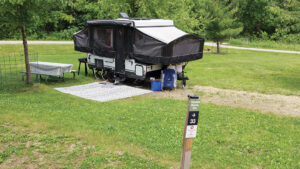
Pine Lake State Park has various campsites for campers or tents. Photo courtesy of Iowa DNR
State park camping
For a more traditional camping experience, Iowa’s state parks offer abundant natural beauty. We spoke with Jordan Munson, park manager for Pine Lake and Union Grove state parks, about Pine Lake State Park.
Located about 90 minutes north of the Des Moines metro, Pine Lake is celebrating its 100th anniversary, making it one of Iowa’s oldest and most beloved state parks. While improvements have been made over the years, the park still retains much of its original charm.
“We have a 76-site campground that offers full hook-up sites, which are electric, water, and sewer, and we have two of those, and then we have electric sites, and those are as advertised, just electric sites,” Munson said. “We offer two shower buildings that have restrooms and showers with hot water and then we also have four overnight cabins, so if someone wasn’t looking to come and camp, they could come and stay in some of our cabins as well.”
Pine Lake offers access to Pine Lake, Upper Pine Lake and the Iowa River.
“A lot of what people are doing is fishing, boating, kayaking, canoeing on the lakes around the river. Families from everywhere around the state just come here and utilize the resources that we offer,” Munson said.
Unlike many private campgrounds, Pine Lake attracts a mix of tent campers, pop-up campers, travel trailers and RVs.
Activities largely depend on what visitors want to experience.
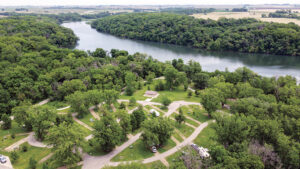
The lake at Pine Lake, ready for kayaks, canoes and fishing. Photo courtesy of Iowa DNR
“We offer about a two-and-a-half-mile bike trail that runs through the park, and then that connects to some of the other Rails-to-Trails and other bike trails around the area, so we get quite a few people that are out biking those trails, and then also utilizing our hiking trails as well,” Munson said.
While Pine Lake has its regular visitors, many come specifically to experience the area’s natural beauty.
“Get out and explore the park if you’re in Pine Lake. Definitely get out and explore our bike trail, along with kayaking or canoeing on the river. It’s about a three-hour trip between Steamboat Rock and our river access, and it’s a really cool section of the Iowa River that people can use,” Munson said.
Munson also recommended Ledges State Park in Boone and Rock Creek State Park in Kellogg. Smitherman cited Whiterock Conservancy as one of his favorite destinations.
Camping reservations at Iowa state parks are required, but the process is designed to be convenient.
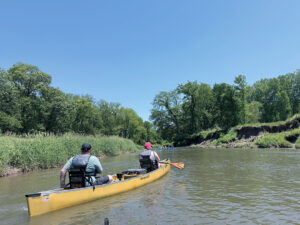
Paddling can be found at various state parks and lakes, with this trip happening in Madison County. Photo by Collin Smitherman
“State parks in Iowa are 100% reservable campgrounds with same-day reservations. So, if you wake up one day and you want to go camping, you can look up online or call the call center and get real-time availability for a campsite, make the reservation that morning, and then show up and camp at the park that day,” Munson said.
According to the Iowa Department of Natural Resources, Iowa offers more than 4,300 campsites for overnight visitors. Options range from primitive hike-in sites and cabins to full-hookup sites with water, sewer and electrical service. Reserve at IowaStateParks.reserveamerica.com or call the call center at 1-877-427-2757. ♦