
Before the Saddle, there was Country Cove
6/3/2026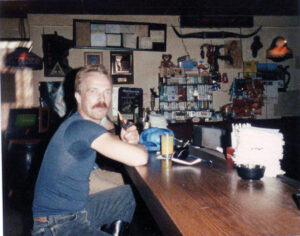
Bob “Mongo” Eikleberry at the Country Cove in 1979. Mongo would eventually open up The Blazing Saddle in 1983 and owns it to this day with Bryan “Stinky” Smith. Photo by Gary Moore
Exactly two years ago, I was eagerly waiting for the premiere of “The Last American Gay Bar” at the Varsity Cinema here in Des Moines. My closest friends joined me in making this series that told the history of the gay community of this city, along with the untold story of the state’s oldest queer bar, The Blazing Saddle.
For my 39th birthday, my friend and frequent collaborator, Nick Ford, found me a copy of Drummer magazine from 1978. It was an “all men” adult magazine that had a cover story on filmmaker Wakefield Poole. Poole was a pioneer in both queer and straight XXX films, often pushing the fantasy tone more than he did the sex.
While flipping through pages, I found a full-page spread that was just a list of bars and what states they were located in. The title at the top of the page read, “Men’s Bar/Bath Scene ’79.” I immediately let my eyes scan the columns of the page to look for Iowa. One bar was listed: Country Cove, located at 321 Court Ave. in Des Moines.
A gay bar/bathhouse in Des Moines.

I learned later that the bathhouse part was either short-lived or never fully realized. Some say it never was a bathhouse; others have said it might have opened a couple of the apartments on the second floor for use. There might have just been a bathtub, a mattress and a couple of towels.
The Country Cove was located where Pints is now. It sat between two adult bookstores. One of them was called Page IV and was also a frequent hangout for men in the gay community. The one on the Court Avenue side was called Court Street News Adult Bookstore.
The bar was owned by Chuck Brooks, brother of Des Moines City Council member Archie Brooks.
Chuck was an entrepreneur in the gay bar world of Des Moines. His most famous operation was City Disco, which ran from 1975 to 1979 and gradually evolved from a gay bar to a place where everyone was welcome, as it had the biggest dance floor in the state. It was located at 541 Sixth Ave. across the street from Saint Ambrose Cathedral.
His other ventures included the Corn Parlor at 928 Sixth Ave. and the short-lived Boardwalk that replaced City Disco in 1979. He also co-owned The PS Lounge with Peggy Sample.
The Country Cove was a Levi/leather bar not unlike the early days of The Blazing Saddle but with a slight Western undertone.
That term should be somewhat self-explanatory, but for those who don’t know, I can elaborate.
The early gay bars were for men only and no straights. The dress code was Levi jeans, leather vests and boots, and shirts were optional. No pictures were allowed, and you let people know what you were “into” by placing colored bandanas in your back pocket — blue, red or yellow in either the left or right pocket of your jeans.
Gays and lesbians were separated and remained that way until AIDS hit Iowa hard in the late 1980s. Only then did some unity happen, and the women served as nurses in the underground hospices that were set up in homes in residential neighborhoods around the city. There were some women who were bar owners, but even those bars were men only.
The bar itself wasn’t anything special. The vibe inside wasn’t much different than Greenwood Lounge is now. A hand-cut bar with a cigarette shelf at one end with bull horns hanging from the wall directly above. Black plastic ashtrays every couple of feet spread across the bar.
Unfortunately, the Country Cove came to an end in 1979 when the building caught fire on the second floor.
This was also a strange recurring theme in the bars that were owned by Chuck Brooks. City Disco and The PS Lounge eventually caught fire as well.
The last bar Brooks operated was the Barbell Athletic Club, which operated from 1987 to 1989 and was co-owned with Connie Roper. The Barbell Athletic Club did not go up in flames; however, it closed due to an ongoing drug problem involving the hip new trend of crystal meth.
Des Moines has never been able to sustain more than two or three gay bars at a time. The most I ever saw was four, and that only lasted a few years.
But gay bars have existed in Des Moines since the early 1960s when Marlys Watson and her husband, Marty, owned the Pink Poodle on Court Avenue and the Blue Goose at 206 Third St.
There is an even earlier note about a gay bar from the late 1950s called Sunnyside that was located where the downtown Mercy Holiday Inn is now.
Places like the Country Cove rarely survive in photographs, official records or public memory. They lived mostly in whispers, rumors and stories passed from one generation to the next. But they mattered. These bars gave queer Iowans a place to exist openly — or at least as openly as the times allowed. Long before Pride festivals, corporate sponsorships or rainbow crosswalks, there were hidden doorways on Court Avenue, cigarette smoke hanging over crowded bars and people quietly building a community in the shadows. Des Moines’ queer history did not begin with acceptance. It began with risk, secrecy and the stubborn determination to create spaces where people could finally feel less alone. ♦
Kristian Day is a filmmaker and writer based in Des Moines. He also hosts the syndicated Iowa Basement Tapes radio program on 98.9 FM KFMG. Instagram: @kristianday | Twitter: @kristianmday