
Going, going, gone online
9/30/2026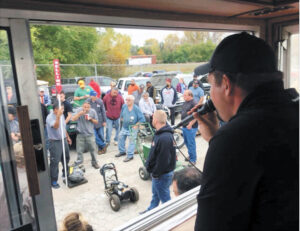
Jason Dvorak, owner of Dvorak Auction Services, sells items at a live auction. Auctions were held outdoors or in their auction facility, depending on the type of auction being held. Photo courtesy Jason Dvorak
Before the digital age, people gathered in homes, farms and auction houses to bid on items from estates. Food was often provided, friendships were formed, and memories were made.
Travis Mansfield, owner of NativeBid Auction Services, grew up attending in-person estate auctions with his grandfather.
“I loved it,” he said. “You could find these amazing treasures, and I loved that everybody was there, bidding, and nothing was going to be sold for more than somebody was willing to pay for it.”
Those memories of hard work and the rewards that followed are one of the primary reasons why Mansfield started his own auction business.
The fun and hustle
Although NativeBid is an online auction company and deals with returns from online retailers rather than estate auctions, Mansfield tries to capture the fun and hustle of old-fashioned, in-person auctions.
“There was real work involved, but the reward was really good deals, and we try to capture as much of that experience as we can using the digital format.”
Stacy Lupher, owner of By The Perfect Pick, started her estate auction business 15 years ago when her mom became ill and had to retire early.
“I was trying to think of a job that we could do together, and I was going to do estate auctions,” she said. “She passed away before she could help me, but she told me to continue to do what I was doing.”
For the first three years, Lupher held estate auctions before transitioning to estate sales.
“We started out doing auctions on site where people would come to the building and we would hold the auction and do pretty well,” Lupher said. “Then it switched to more estate sales where we would hold them in someone’s home.”

A live auction of outdoor equipment held by Dvorak Auction Services. Dvorak Auction Services held live, in-person auctions before the COVID-19 pandemic forced them to move online. Photo courtesy Jason Dvorak
Estate auctions and estate sales
Estate auctions use competitive bidding, while estate sales have fixed prices. Both involve liquidizing an entire estate.
Estate sales allow buyers to know what to expect, but items are sold on a first-come, first-serve basis. Estate auctions can become quite competitive, driving prices higher.
Auctions can be a lot of fun, Lupher said. Live, in-person auctions create a sense of community, allowing people to meet face to face while searching for interesting items.
The digital age and the COVID-19 pandemic changed the environment in which estate auctions had once operated.
“When COVID hit, a lot of people that do auctions on site switched to online, and they really haven’t gone back because actually they make more money (online), to be honest with you,” Lupher said. “Doing it online, they’re going to reach a lot more people further away than locally.”
Jason Dvorak, owner of Dvorak Auction Services, used to hold live, in-person estate auctions in Des Moines three to four times a week.
Dvorak and his employees would go to the home, collect the items to be auctioned and bring them to the auction facility. Once there, they would present the items to make them appealing to buyers and advertise them for the upcoming auction.
Chairs were arranged around the facility, and concessions were available, often including hot dogs and hamburgers.
“People would sit there, hang out and enjoy themselves, bid on items that they were interested in, and last for sometimes three to five hours,” he said.
Dvorak had customers who held permanent bidding numbers.
“You get to know people so well that they didn’t even have to really register for the auction, but I would know what their number is,” he said.
The shift
Even though auctions have moved online, Dvorak still knows many of his returning customers. But he said the experience is not what it used to be.
“In today’s world, for whatever reason, people don’t want to spend three hours sitting in an auction anymore. They seem much busier, and they don’t want to take the time,” Dvorak said.
The shift to online auctions makes them more beneficial financially for sellers and buyers, but it has dissolved the sense of community Dvorak once knew. Even so, Dvorak does not believe returning to in-person auctions would benefit his business or his customers. He can now reach a wider audience, having shipped items as far as Canada, Australia and Germany.
Online auctions have also eliminated some costs for sellers. Food is no longer served, and sellers don’t need as many employees to run an auction. Dvorak once had five full-time employees who helped transport items, set up auctions, and prepare for the next day.
“It’s a little bit less expensive, but I miss it. I just miss going to auctions where it was like a community,” Lupher said. “But online is good, too, for others. So everybody’s got their own opinion on that.”
Online auctions can last for weeks, while an in-person auction typically lasts a day or two.
As the internet leaves those who remember in-person auctions longing for the past, it has drawn younger generations — those who have never known a world without the internet — into a new community.
“They’re looking for vintage clothing, and it’s kind of interesting to see because before it seemed like it was older people looking for their collectibles, or resellers, and to see the younger crowd looking for items, too, it’s quite the adventure, and it looks like they just have a blast,” Lupher said.
Mansfield has noticed the same shift in audience.
There can be something for everyone at estate auctions and sales. Although the community has changed, a new one is forming.
“There’s youngsters, who never have experienced an in-person auction, experience the online auction, and I can see that when they come in the door. There’s the same element that I had as a kid,” he said. “It’s fun, it’s exciting, sometimes they see their friends there and are like, ‘Oh, you know about this place, too?’ ”
Mansfield said his audience consists of hustlers, and he knows the auction community isn’t for everyone.
“In a day where you can have same-day delivery brought to your door, the thought of getting in your car, driving somewhere, going inside, loading it up yourself, loading it in your car to get home, all those things, whether you’re going to resell that or use it in your home, that’s just a lot of pieces that not everybody is interested in doing,” he said. “But if the deals are good enough, the people will do it. If the customer service is there, then the overall experience is there.”
Although Mansfield misses the hustle of in-person bidding, he still sees the work people put into online bidding and considers it the future. The internet has also made the auction industry more accessible to people interested in bidding.
“The internet has allowed more people to be able to bid on items when they’re available, when it’s handy to them,” he said. “If they’re at work and they can take a break, or if they’re at home after 5 p.m., they don’t have to drive down somewhere to participate in it.”
Despite being an online auction service, Mansfield has great respect for those still participating in live estate auctions. One reason people prefer in-person auctions is that they can see items before deciding how much to bid.
“I really believe that they’re people that just love to go through the estate,” Mansfield said. “I think there is still a very good buying community that would love to go in-person and see these items, and sometimes it’s hard to put a price on something unless you see it in-person, like jewelry and other items of value.”
There are additional aspects of in-person auctions that draw people in. They are an experience, a treasure hunt and a place where stories can be shared and memories made. But the online auction industry brings its own benefits, allowing people to participate from anywhere, reaching a larger audience and drawing in a new generation of bidders.
The goal
Whether done in-person or online, Dvorak’s reason for holding estate auctions remains the same: to help people liquidate their assets, a process that can often follow a difficult time, such as the loss of a loved one or financial hardship.
“The goal is to help people move on from whatever situation that they’re in,” Dvorak said.
Helping others is one reason Lupher has stayed in the industry.
“A lot of people that may not be in a good situation and need help, as far as if they’re moving or downsizing, sometimes someone has passed away and they just need help,” she said.
As the world of in-person auctions fades away and becomes a memory, many businesses are ready to welcome bidders to the community of online auctions.
“You have to adapt and change with the times and the people,” Dvorak said. ♦