‘It took a disabled man to lead a disabled nation’
4/1/2026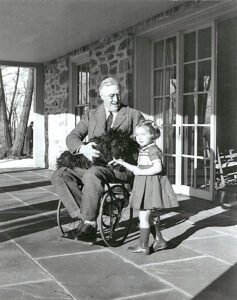
President Franklin D. Roosevelt on the porch at Top Cottage in Hyde Park, New York, with Ruthie Bie and Fala. February 1941. This photograph was taken by his friend, Margaret “Daisy” Suckley. Ruthie Bie (later Bautista), then 3 years old, was the daughter of the property caretakers. Source: Creative Commons/FDR Presidential Library and Museum. Photograph by Margaret Suckley.
It’s head-spinning to be at once depressed and optimistic.
But there I was. Somewhere between ideation and actualization. Something pulled me back. Mostly curiosity, I think. Wanting to know what happens next, a reporter’s DNA, has gotten me through a lot. You gotta live to see tomorrow to know if you were right yesterday.
Like farmers crushed under the weight of skyrocketing interest rates, steelworkers displaced by corporate greed in the 1980s, we’d lost everything — the family business, our familial connections themselves, identity, income and purpose — as we had to give up the Carroll Daily Times Herald, the love of my life, the all-in for me, after 93 years and three generations of ownership.
We had to sell what we’d built to avoid foreclosure on mom’s house, my house, forfeit our role as builder in the community in which we’d been in a century-long ensemble cast of builders.


On Dec. 1, 2022, three generations and 93 years of family ownership of the Carroll Times Herald ended. It was like being at your own funeral and parole simultaneously — the death of what bound our family and defined us, but also a release from a prison of unsolvable problems in a challenged industry during a cultural tornado watch for democracy.
We walked slowly that day, mom and I, across Court Street to sign the sale agreement at the Carroll Public Library, a new public facility our newspaper championed for the better part of a decade. We desperately did not want to sell but had exhausted all options. We signed the arrangement at the nearby library so the deal would be done before we walked back to the paper and informed staff.
A few days later, crushed, I honored a long-scheduled agreement to moderate a forum, to conduct a one-on-one public interview in the Harkin Institute’s theater with Congressman Ro Khanna, a Democrat who represents California’s Silicon Valley and is in the early discussion as a candidate for the White House in 2028.
We weaved through a wide range of topics but focused intently on the rural economy, ways to see that the wealth and optimism scooped and segregated to places like Silicon Valley spreads to neglected, left-behind regions of the nation, cities that have been seemingly read their last rites — places that look like I often feel, hollowed out, stretching to summon fight from a parade of defeats and indignities.
Among those in attendance that night at the Harkin Institute: State Rep. Josh Turek, D-Council Bluffs.
Turek is now seeking the Democratic nomination for the U.S. Senate.
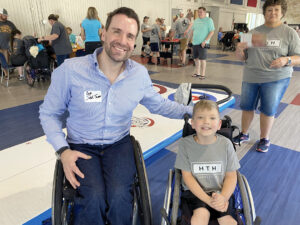
State Rep. Josh Turek talks with then 6-year-old Hayes Hofmeister in Des Moines during a summit on advocacy for people with disabilities. Photo by Douglas Burns
I talked with Turek after the Harkin Institute session. And I listened as he chatted with Congressman Khanna and others in the room. Intrigued by Turek’s story, the fact that he won in a challenging, red, western Iowa Statehouse district as a Democrat, and impressed by his defiance of his own disability, I wanted to learn more about Turek as he seemed to me to potentially hold the formula, or at least have it in reach, for what Democrats have sought for 12 years in Iowa — a statewide candidate with electability — a winner. A connective and compelling biographical narrative matters.
So I started covering Turek when I could, interviewing him at length, working to confirm if my instincts that were built over 30 years of political coverage in this state were reliable.
I covered Turek in Red Oak, his native Council Bluffs, Ankeny, Des Moines, Iowa City, Harlan, Ottumwa and other reaches of Iowa.
One Saturday afternoon, before a community event for Latinos in Council Bluffs, I was interviewing Turek on a range of topics. The economy and job loss emerged. So I let my own sorrows get the best of me and engaged in all-American self-pity. I relayed our story of business and personal loss, of economic struggle with the newspaper.
Turek, sitting in a wheelchair, having endured 21 surgeries related to spina bifida by age 12, let me exhaustively roll through the pain, the experience of our family, our loss. He looked me in the eyes, never interrupted me. I could tell he understood, that through his own lived experiences, he could tap into my turmoil.
Then, in the interview, Turek, the first visibly and permanently disabled state legislator in Iowa, said this to me:
“I think probably 85% or 90% of the people who are in my sort of condition, or with similar disabilities, this situation breaks them and they don’t go on to live meaningful, successful lives,” Turek said. “But the ones who do come through are stronger, and those make the most interesting, hard-core people. Some of those that get broken become harder in the broken places. It’s totally true. The struggle builds the character. If you can get through that and it doesn’t completely break you, it makes you stronger, a much more interesting individual.”
Turek shot me a knowing smile. He got that I got it. That’s the moment I had my confirmation about Turek.
This guy finds a way. I should be able to as well. And, yeah, he’s right, these struggles, if you can clear them, make you more interesting. He certainly is.
“There was this old saying about Franklin Roosevelt,” former U.S. Sen. Tom Harkin, D-Iowa, said in a Council Bluffs speech for a Turek Statehouse race event. “I’m going to use the old vernacular. ‘It took a crippled man to lead a crippled nation.’ Well, we don’t use those words anymore, so we say, ‘It took a disabled man to lead a disabled nation.’ Need I tell you that we are somewhat disabled in our country right now?”♦
Douglas Burns of Carroll is fourth-generation journalist and founder of Mercury Boost, a marketing and public relations company.