
Edgard Camacho at Flora
3/4/2026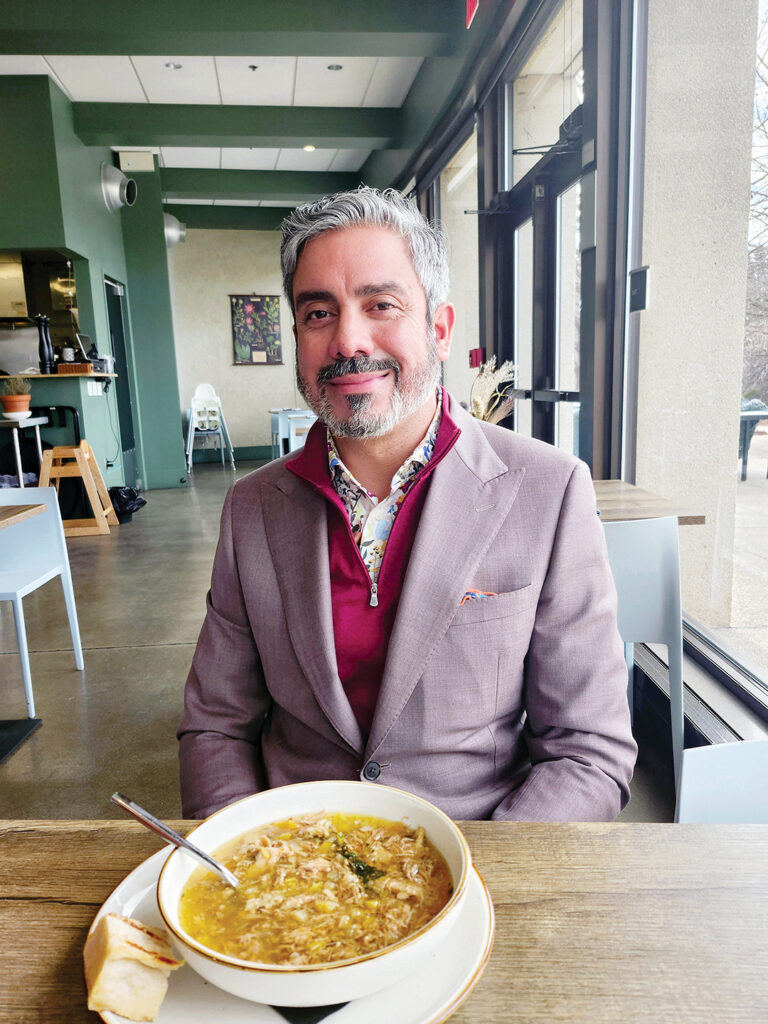 Edgard Camacho is a French-born Venezuelan-American artist. We asked him to lunch recently, and he chose Flora, Suman Hoq’s café in the Greater Des Moines Botanical Garden.
Hoq has characterized his lunch and brunch offerings with transcultural touches from his East Bengali heritage. Soups are fantastic with a chickpea soup of Massaman curry, coconut milk and greens sharing the menu with others that change daily. Basmati rice and tandoori tofu can be added to any dish. A goat meat taco was made with a tortilla that resembled a Bengali fried bread. Over soups, sandwiches, tacos and Bloody Mary’s adorned with pickled chilies, we talked about Camacho’s long, strange trip to Iowa.
Edgard was born in France but is he French?
“My father worked in the petrochemical business in Venezuela. He was sent to France to communicate better with international culture and technology. In France, one must have a French parent or grandparent, or live in France 13 years to become a citizen — even if he is born there. I grew up Venezuelan. Venezuela borders Brazil, so I learned enough Portuguese to empathize with Brazil. Brazilian-Portuguese is different from Portugal’s Portuguese; it’s more melodic.”
Who will he cheer for when the World Cup comes to America this summer?


“Brazil, but also Argentina, Columbia and Spain. Maybe France. Once in Des Moines, I was cheering for Brazil in a game when everyone else was for a Central American team.”
How did growing up in Venezuela influence his art?
“In Venezuela, you realize at a young age that things are both beautiful and dangerous. I am fascinated by snakes — so beautiful yet venomous. I walked in ponds with piranhas. I saw caymans in the wild. I swam in the Orinoco with dolphins. Life was so beautiful, but so dangerous.”
Camacho attended Universidad de Oriente for industrial engineering. How did he become an artist out of that background?
“I was always interested in art even as a child, but my parents discouraged that. It wasn’t part of their culture. After a couple years, though, I transferred to Escuela de Arte Armando Reverón as an independent artist researcher to study stone sculpture with Valentín Malaver.”
Communist strongman Hugo Chavez took power in Venezuela in 1999. How did that effect Camacho’s life?
“I saw what was going on every day. I was a journalist and was very political then. I had a radio show, comedy and satire about the government. I would get death threats. I saw a government-led mass murder on TV and painted a piece about it. It was noticed and became part of ‘La Megaexposición: The Best of Venezuelan Art of the 21st Century.’ By the time that touring exhibition happened, I was exiled. I left Venezuela in 2004. I was 25. Exile is very painful. I don’t think you can really know that until it happens to you.”
How did he get out?
“I had a grandmother who was Cuban-American. She lived in exile in Miami, so our family was able to fly there. The Roman Catholic Church sponsored us.”
What was Miami like for a refugee?
“It was weird. I went to school (New World School of the Arts) and worked in Miami but lived in Broward County. All of that area seemed unnatural. It is built on landfill poured into swamps. You can’t dig a hole in Miami to plant something without water oozing up. The heat and humidity were intense because everything was built on swamps.”
How did he get to Iowa?
“I saw an advertisement on the internet, on Facebook, recruiting for Maharishi International University in Fairfield. I responded, and they sent me an airplane ticket to come study there.”
At MIU, he studied with James Shrosbee, a Guggenheim Fellow, ceramic artist and painter who caught CITYVIEW’s eye in the early 1990s. Did transcendental meditation, and Iowa, effect Camacho and his art?
“The day I arrived in Iowa, it was snowing. I knew my life was changing, completely. I left politics behind. I don’t want that kind of influence in my art. I owe everything, certainly my happiness, to Iowa. I found my wife and family here. I found so many cultures interacting in Iowa. As a substitute teacher in West Des Moines, I noticed that Asian kids would not look at my feet. That was a sign of disrespect, and respect is essential to their culture.
“That is very different from Venezuelan culture. In Latino culture, you want to look your best no matter what. My sister’s bridesmaids all dressed very flashy at her wedding. But was that offensive to locals? I especially learned a lot from special education students. They have so much innocence and presence in the moment. We all learn so much in this clash of cultures.”
Edgard has been very well dressed whenever I have seen him, in a manner that is far from traditional Iowa dress codes. At our lunch, he wore a suit coat and vest with a floral print shirt.
“This is not a statement; it’s my uniform. I wear the floral shirt because I am from Venezuela. I worked a lot in retail. I even worked in a swim suit store. The tropics become a part of you. They are mainstream to Latino culture.”
Steven Vail is an international art dealer who represents world famous artists, some personal friends. He is the only dealer not on the coasts who represents Chuck Close’s estate. How did Camacho catch his eye?
“After a show at Olson-Larsen, and he wanted to talk. After a conversation, he said ‘You are an international artist. I want to represent you.’ I realized then that I only want to keep working. That’s not easy for an artist with kids. Vermeer had eight children and never had a show in his lifetime.”
Camacho’s latest show, at Moberg Gallery, reveals lots of shapes and colors from collected materials, particularly fine clothing. How did that evolve?
“I love rearrangement. It’s about coping and evolving. Many of the fabrics came from Badower’s (men’s clothing store). He was himself a Holocaust survivor. As an exile, I identify with him. I found these elegant cashmere jackets discarded and consigned to second hand stores. I love to use their swabs. It’s about restoring value.” n
Jim Duncan is a food and art writer who has been covering the central Iowa scene for more than five decades.