
‘Good Luck, Have Fun, Don’t Die’
3/4/2026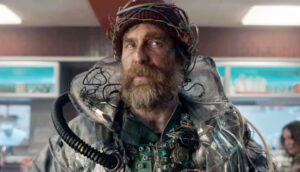
“Good Luck, Have Fun, Don’t Die”
R | 134 minutes
Director: Gore Verbinski
Writer: Matthew Robinson
Stars: Sam Rockwell, Juno Temple, Haley Lu Richardson
When was the last time a studio movie made you genuinely uncomfortable? Not in a jump-scare or gore-centric way, but in a “wait, did they just go there?” way that lingers in your brain for days? Gore Verbinski’s “Good Luck, Have Fun, Don’t Die” poses that question repeatedly, and the answers are not always comfortable. But they are, without exception, memorable.
The premise is classic high-concept pulp: a scruffy, unhinged man (Sam Rockwell) bursts into Norm’s, a late-night Los Angeles diner, claiming to be from the future. He needs to recruit patrons to help him stop a young boy from programming an AI that will eventually trigger the apocalypse. To ensure their cooperation, he has strapped a “reset bomb” to his chest.
The twist on the “Groundhog Day” formula is great: Rockwell’s character has lived this night over and over and over again. We are joining him on a run where his empathy for the people he is saving has completely evaporated. He is not a hero; he is a frustrated gamer trying to speedrun a level he has failed more than 100 times before. This roguelike structure gives the film a frantic, propulsive energy. Rockwell carries the movie with a perfect blend of wisecracks and sincerity, shaming and shamaning his crew along through a narrative that refuses to slow down.
What follows is less a linear narrative than a satirical meat grinder, with Verbinski feeding contemporary anxieties about technology, grief and human connection into the blades and seeing what emerges. The results are, depending on your tolerance for chaos, either a magnificent mess or messy magnificence.

While the “man from the future” provides the framing, the heart of the film lies in three extended flashbacks that detail how the diner patrons’ lives were dismantled by technology. The first, featuring Michael Peña and Zazie Beetz as stressed-out teachers, is the weakest — a bit too much “old man yelling at clouds” as it depicts phone-addicted students.
It is also the only segment that lets older generations off the hook entirely, framing this as a youth problem rather than one we all created. (Because, of course, it is.)
But then comes the second flashback, and suddenly you have an idea why Verbinski needed a decade to get this made. After losing her son, Susan (Juno Temple) is led down a rabbit hole of secret cloning corporations that offer to replace her child with a bizarro clone trained on AI and early-aughts radio ads. The sequence where she customizes her new son like an iPhone — complete with a cheaper “with ads” version — is chilling. It also touches on the frequency of school shootings with a bravery that borders on the reckless. Verbinski posits a world where tragedy is so common that corporations simply offer a hardware replacement rather than addressing the systemic rot. This movie does not shy away emphasizing how technology serves as both an inadequate salve for tragedy and a distraction from its root causes.
The third flashback, featuring Haley Lu Richardson as Ingrid, a woman “allergic” to Wi-Fi, initially comes off as the most grounded — until you remember she is wearing a princess dress through most of it. Richardson finds genuine pathos in a character forced to watch relationships dissolve because she cannot participate in the artificial reality everyone else occupies. It is here that Verbinski’s visual imagination truly ignites, filling frames with surreal images that would not feel out of place in a particularly unhinged fairy tale. It is a powerful look at a world where parents find the “moments of silence” provided by an iPad more desirable than the actual responsibilities of parenthood.
The production values punch far above what must have been a modest budget. James Whitaker’s cinematography is slick and inventive, particularly in color grading and lighting. Geoff Zanelli’s upbeat score deserves a standalone listen. The action sequences demonstrate Verbinski’s mastery of slapstick mayhem. And the creature designs? Let’s just say you may never look at a cat the same way again.
Here is where the film will lose some viewers: it is genuinely, unapologetically bitter. Anyone expecting the conciliatory notion that “we just need safety guardrails programmed into AI” will find themselves spat upon. Verbinski explicitly depicts that idea as a phony world where brainrot-parody monsters literally urinate glitter on you.
In an era of sanitized studio filmmaking and content designed to glide past without friction, Verbinski has delivered something difficult to forget. It is a wild, unhinged ride that reminds us that no person can be replaced by a machine, no matter how much glitter that machine can piss on you. It grabs you by the collar and screams directly into your face — and, just maybe, that is exactly what we need. ♦