
A megachurch pilgrimage
4/1/2026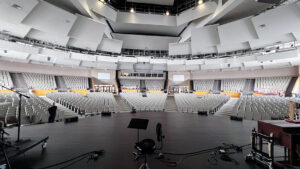
Lutheran Church Of Hope West Des Moines
IN THE BEGINNING …
I wear a dark suit.
It’s my first visit to a megachurch, and it is for a funeral. It is confusing in this day and age to know what to wear to church. Your best clothes? Business casual? Shorts and a T-shirt? Got me. Back in the day, I would tell young lawyers who might ask what to wear for a court appearance … well, wear what you would to a wedding or funeral or Sunday church.
Not true anymore. It is a free-for-all when it comes to church dress. But today I wear my dark suit anyway. Listen, I’m an old dog in a sea of jeans and shorts and sweat pants.
Speaking of being out of touch, when I enter the pew, it isn’t a pew. It is some type of Barcalounger with a coffee cup holder. Plus the arena seating and big screens at the front of the church? WOW. Is there a vendor selling hot dogs and beer? The dead guy — my friend — would certainly appreciate that amenity and might even want me to ask for extra mustard. I relax comfortably into my plush chair and smile.



Yup, this is a far cry from my 1960s traditional Catholic upbringing of hard wooden pews with wooden kneelers topped by a thin pad and absolutely no multi-media presentations except song numbers written on a blackboard by Sister Timothy Mary — with whom I’m still in love. Nor is the lively funeral service like my college studies of the Old Testament with my professor, Rabbi Jay Holstein, who never once put a biblical verse to guitar music or ever asked me to raise my hands for Jesus.
But, my goodness, this latte from the church coffee shop sure is delicious, and people sure are friendly.
What is going on with these megachurches? Why do they draw the crowds? Where is the spirituality among all the big screens and flash and cafes and rock bands? And why are salt-of-the-earth, common-sense Iowans attracted to these churches?
So I decide to go on a pilgrimage. You know, like the Camino de Santiago for Catholics or the Hajj to Mecca for Muslims or a trip to bathe in the Ganges River for Hindus. My pilgrimage is to stop at a couple of the megachurches in the Des Moines area to see what everyone is talking about and to see what they say to a nonbeliever like me.
But first, what is a megachurch? The Hartford Institute for Religion Research says that a megachurch “describes a group of very large Protestant congregations” that are generally “2000 or more persons in attendance at weekly worship … at all locations;” and have “a charismatic, authoritative senior minister;” with “a very active, seven-day a week congregational community;” and “innovative and often contemporary worship formats.” There’s more, but that should get us started.
ON THE FIRST DAY…
 Lutheran Church Of Hope West Des Moines, 925 Jordan Creek Parkway, West Des Moines
Parking lot attendants? I come to discover this is the norm at all the churches I visit. And, I must admit, it doesn’t get much better in life than to be greeted by a person in a yellow vest with a big smile and clear directions for where to park.
I make my way through the sea of cars to the front door to attend the Sunday service at Lutheran Church of Hope. By the way, if you think Sunday is busy, look at the typical Monday — Storytime with God, Monday Morning Moms, Prayer Shawl Ministry, AA, Women’s Bible Study, Grieving Mothers, Gambler Support, Lenten Journal Making, Online Study, Orchestra Rehearsal, Parents of Addicts, Men’s Study Group, and Chapel Brass Rehearsal. My goodness, that list is exhausting. There are no “idle hands” here. And check out that guest speaker at Storytime.
I chat up the woman working at the coffee shop and cafe and ask about all the breakout rooms I can see around her space. She laughs and tells me they are constantly full of various groups all day long. Really?
Shall we look at the place of worship … ?
OH MY LORD! The last time I saw a venue like this was when I attended a Denver Nuggets game.
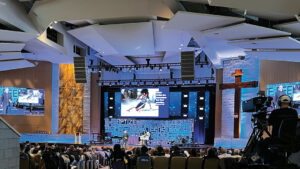
Senior Pastor Mike Housholder begins his sermon. It is heavy in the language of sports and current events and images that flash on the big screens. For example, he speaks of the Winter Olympics and the great Norwegian slalom skier Atle Lie McGrath. How McGrath had the gold medal sewed up and only had to stay up for his last run down the mountain. And he didn’t. McGrath missed a gate by a fraction and was disqualified. Pastor Mike told how McGrath threw his poles off the course, took off his skies, and walked into the forest. Alone.
“Who’s going to walk along side of you in the depth of despair? We do mission to tell others that Jesus will walk with you … You were made for compassion. You were made to have compassion for people who are broken. You were made for a life of caring. The legal immigrant and refugee needs someone to walk alongside them with compassion.”
You get the idea. I may have stumbled into this church because of the Barcalounger and the coffee, but watch out, they are interested in the salvation of your soul.
Lead Pastor Jeremy Johnson meets with me later in the week. A middle-aged, fit man with a soft voice and kind eyes. I ask him about the numbers — 20,000 worshippers each weekend at seven campuses. Unbelievable! Especially because in 1993 Lutheran Church of Hope had less than 20 worshippers at an office suite in West Des Moines.
What is going on?
“What is being shown statistically is similar to what we’re seeing at Hope, that the biggest demographic of people that are coming to church with the most regularity are Gen Z. These are high school and college students that are coming independent of their parents.”
Why?
“For starters, I think people are exhausted from being judged by performance and comparison. And I think people are looking and they’re searching and they’re finding that Jesus doesn’t compare you based on everybody else.”
OK.
“People think life is bigger. And Jesus invites them to a better and a more abundant life. And, in that, there’s comfort. And, in that, there’s a little bit of challenge. Jesus says, hey, I have a better way for you to live your life and I have grace for you and that doesn’t go away.”
Is this message unique to Hope?
“We’re doing the same things that every other church is doing. Every church is saying, hey, there’s a guy who loves you. He created you. He’s given you these gifts to love and serve your neighbor. Love God with everything that you have, and then love your neighbor as yourself.”
That “love your neighbor” business has taken quite a hit in the United States, I muse out loud.
“Especially because of that very divisiveness, church is important. Wow, to be a part of a mission that brings people together rather than drives them apart, doesn’t that sound so satisfying? That’s what attracts people when they walk in the door.”
And Pastor Jeremy smiles. I smile. He believes. I don’t. But his obvious warmth and his love your neighbor as yourself? Amen to that.
AND THEN THERE IS…
 Reach Church, 2725 Merle Hay Road, Des Moines
Folks are flowing into the 11 a.m. service at Reach Chuch. One of the ushers is an old friend from my assistant county attorney days. I ask her about all the people coming into church.
“Well, Joe, you can see all these young people coming in the door, and also many people from diverse backgrounds, and then there are older folks like me and my husband. The vibrancy of this church is what speaks to us all.”
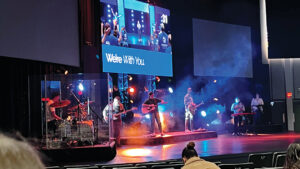
And the church is vibrant. The altar is a rock-and-roll stage with the drummer behind glass, guitarists spread across the raised platform and the singers up front. A young preacher on stage begins to speak of Jesus and the resurrection — and then seamlessly weaves it all into a song. The lights start flashing, the smoke machines start smoking, and the music takes off.
My traitorous body starts swaying.
“For the tears, for the blood, that was willingly poured” is sung out by the performers on the stage as we all dance and raise our hands. And young people form a mosh pit at the top of the altar, and we sing louder and sway even more. A sweet ecstasy for believer and unbeliever alike.
And then Pastor Cullen Allen gives a sermon with a preacher cadence that ebbs and flows from fireside chat to religious fervor. He blends complicated theological ideas with very clear concrete action plans. His hands fly out emphasizing every word, and then he abruptly stops — dead quiet — only to run to the other side of the stage and begin again.
“Because of that truth of Jesus dying on the cross and rising from the dead,” Pastor Cullen pauses and begins to turn his body from one side of the congregation to the other with more and more exuberance as he riffs, “… we have healing … we have freedom … we have blessing … we have abundance … we have wholeness … we have favor … we have prosperity … we have strength … we have protection … we have his presence … we have direction … we have peace … and we could go on and on and on and on.”
Everyone whoops and hollers and shouts amen.
“We have people in our church who have been here decades. And many of your new people are coming from the city of Des Moines. Part of our story, Joe, is that we really feel like God’s called us to the city — in the city, for the city.”
Pastor Cullen quietly talks to me as I sip a coffee and he catches his breath after another high-energy sermon. He explains how the church sold their land out west to focus on a new mission, “to reach the one who’s disconnected from God, new values, a new focus, new everything — to reach and make a difference in the city.
“I really felt like God was asking us to start a dream center, to provide hope for the city.”
So the church launched a nonprofit with that very name — Dream Center Des Moines.
“It already has nine different areas of programming — for example a food pantry, a medical clinic, a pregnancy center, a free store for clothing and diapers, sports camps. We have a component called Together for Good that helps families before DHS gets involved and provides counseling.”
This change of focus for the church has resulted in now having 28 nationalities represented in the congregation, according to Pastor Cullen.
But why do those people come in your door in the first place?
“They feel compelled to come in. And then when they come in, they hear about the love of Jesus, and God loves them, and their lives are often changed. Listen, we want every single person who walks in the doors to feel like they are honored, that they’re valued, that they have dignity, they have respect.”
And those who have fallen away from Jesus?
“We’re not trying to reach people who have it all together in life. If you feel like you’re hurting or you’re struggling, hey, this is the place for you. We all struggle. So we’re not looking for perfect people. We’re looking for people who want hope.”
Pastor Cullen smiles. I smile. One a believer. One not. But it’s difficult not to like this man with his intense gentleness and his embrace of hope. Can I get a witness? Absolutely.
FINALLY, THERE IS…
 New City Church, 3114 S.W. 61st St., Des Moines
I arrive before the crowds and barely get seated before the man near me introduces himself.
“Terry Pauley.”
Terry has been going to New City Church for “six to eight years.” Prior to that, he was in ministry in his own right. I ask what brought him in the door.
“We were curious and heard good things about the church. We got here, and it was such a diverse church. Everybody is welcomed, they’re accepted, and the worship makes you feel comfortable.”
What do you think is drawing others to this church?
“I think with everything going on in the world, people are longing to find some kind of hope. People are turning to faith and coming together. All the preachers are good here. And it is those churches that are open and friendly to all types of people that are going to succeed. That is what this church is.”
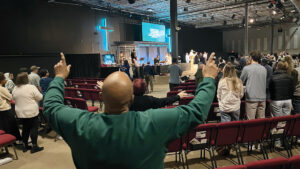
The church begins to fill. The music starts. Again, a full band, great singers and music that gets you standing and clapping and shouting amen. And, on this day, the crowd is actively involved in every part of the worship, from the opening songs to the sermon itself. It is a call and response worship service — full of joy.
“Jesus, we love you,” comes from the stage.
“Yes, we do,” everyone sings back.
Lead Pastor Rod Dooley calls out, “Look up at the words on the screen: ‘Jesus we love, oh how we love you, you are the one our hearts adore.’ Would you lift up your heart with affection toward Jesus? How many of you adore him? How many of you love him?”
The congregation cheers and claps and shouts.
And over the top of the crescendoing noise, Pastor Rod says, “We love him because he first loved us, because he sacrificed his life for us, because he fills us with joy. We love you Jesus. That’s why we come to church — to worship Jesus.”
The congregation gets louder and louder.
And Pastor Rod runs with it: “Jesus we love you. We bless you. We thank you. We worship you. You’re awesome. You’re amazing. Your greatness is so amazing. We thank you Jesus. Hallelujah. We adore you God for being our deliverer. Hallelujah Jesus.”
It is utterly infectious. “Hallelujah,” I shout from my unbeliever mouth.
Whaaaaat?
The power of a joy-filled community and a charismatic leader is not lost on me. Hallelujah indeed.
On the day of my visit, Women’s History Month was being celebrated by women ministers giving sermons over the month and by other special events. Minister Claudette “Deenie” Little preaches about “uncommon unity” and that we must ask Jesus for what we need and want and Jesus will provide in His time. “Amen?” she asks. “Amen,” responds the congregation.
And so it goes. Call and response, response and call.
The welcome mat at New City Church goes far past the parking lots. Even as far as me. Again, this is a house of believers. I’m not. But the warmth of this loving community? That is difficult to ignore.
AND, AT LAST, IT IS TIME TO REST… no more visits
 More than 50 years ago, when I was studying the Hebrew Bible with Rabbi Holstein, he told me a story. He said that, as a young boy, he went with his grandfather to visit an old man reputed to be a mystic. They went into a dark room, and the old man made a heavy spoon lift from the table and fly across the room. The question, Rabbi Holstein said to me, is not whether or not it was a miracle. Rather, what does it mean if it was a miracle?
Hah, don’t you hate people who do that? But his point to me was, do you believe in the Hebrew God because you saw a miracle? Do you believe in Jesus? Do you believe in Buddha? And what does that belief really mean in terms of morality and how you live your life? And was it even a miracle to begin with?
Yikes!
But the messages discovered on my pilgrimage — love your neighbor, reach for hope, embrace community, help the disadvantaged, welcome the stranger, have compassion for the immigrant and refugee, build food pantries, hold clothing drives, give honor and respect and value and dignity to all?
Hmmmm … can I get an amen? ♦