
Cleared for takeoff
9/30/2026On a late fall afternoon in 1954, Iowa Governor William Beardsley got behind the wheel of his own car and headed south from Ames on old Highway 60. He and the First Lady had been visiting Iowa State.
Just after sunset, only a few miles north of Des Moines, as his car overtook a hill, he slammed into the back of a pickup that had slowed to assist another motorist. The governor was killed instantly. Charlotte survived but with serious injuries, including partial paralysis. The family’s little white dog was found alongside the wreckage, unharmed but shivering uncontrollably.
The tragedy did more than end Beardsley’s life. It changed the state’s highest office itself. Iowa governors have traveled with a state patrol trooper behind the wheel since, practical advice that the chief executive shouldn’t be the one steering.
From stagecoach to railroads, from automobiles to airplanes, modes of transport have always shaped how politicians campaign, connect and govern. Today, that journey arrives in the cabin.
The Republican Party gubernatorial nominee, Zach Lahn, has become the latest chapter in a long Iowa tradition. He is a licensed pilot who frequently flies his own airplane, and his choice to fly has revived questions that seem to surface every time politicians travel. He has lots of company.
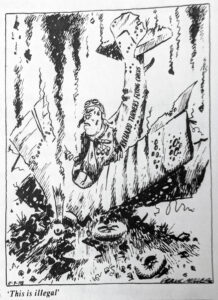
© Frank Miller / Des Moines Register via Imagn Images. Nov. 9, 1978
From stagecoach box to flight deck
Transportation has always been intertwined with Iowa politics. Ansel Briggs, Iowa’s first governor, ran a stagecoach line before office in 1846. Soon railroads replaced wagons and became one of the most powerful political forces in the state. Governor Albert Cummins, part of the national progressive movement of the early 1900s, built his reputation wrestling with railroad monopolies over freight rates and political influence. By the middle of the 20th century, another transformation arrived with paved highways and automobiles.
In 1962, Harold Hughes carried the identity of a long-haul truck driver to the governor’s office, representing an Iowa transformed by highways rather than rail lines — and making transportation part of his unique political biography. But even Hughes had his eye on something faster than a roadway for travel.
Iowa had been an early pioneer in the creation of a State Patrol Air Wing, buying two Piper Super Cub aircraft to monitor traffic and provide emergency services. Soon, governors and other officials were flying across the state, more planes were purchased and political turbulence followed.
In 1967, Hughes had his eye on a twin-engine Beechcraft Queen Air 88 from Elliott Flying Service in Des Moines, but the price tag was over budget. To cover the balance, the Iowa Executive Council voted 5-0 to draw on supplemental funds. But newly elected State Attorney General Richard Turner — already building the combative reputation that would define his career — issued an opinion declaring the purchase illegal, as an end-run around the appropriations process. A confrontation between the two broke out in a Capitol corridor — Turner holding firm in opposition, Hughes reportedly calling him a malcontent.
It was an early episode in Turner’s rather flamboyant career that would keep reporters and cartoonists busy. During his tenure, he sent state agents to raid a local church bingo fundraiser, charging the parish priest with running a gambling house, mused publicly that a chimpanzee in a suit would go unnoticed in the state legislature, and waded in on the question of whether a chicken is technically an animal.
Turner ensnared himself in several aircraft controversies. The following year, the Air Patrol clocked his vehicle traveling 84 mph near Greenfield on Interstate 80. He paid the $10 fine. Later, he battled Governor Robert Ray, who had declined to fund Turner’s own departmental plane. In 1978 he lost his re-election bid to a 34-year-old McGregor lawyer named Tom Miller, who would go on to become the nation’s longest-serving state attorney general.
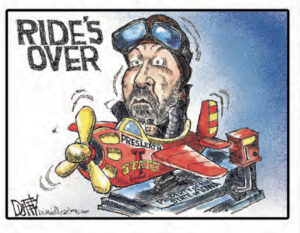
By Brian Duffy, CITYVIEW, January 2015
Bird’s eye view — a heyday for political cartoonists
Frank Miller, the Pulitzer Prize winning editorial cartoonist for The Des Moines Register, instinctively understood that airplanes made excellent political theater.
He marked the defeat with a cartoon that shows a small plane down in flames, its fuselage lettered “RICHARD TURNER’S FLYING CIRCUS,” wreckage and playing cards scattered across the ground, and a goggled Turner climbing dazed out of the debris. The caption, borrowed straight from one of Turner’s favorite lines, reads simply: “This is illegal.”
Turbulence ahead
As the Flying Circus subsided, Iowa political skies appeared to calm for some time.
Then Steven Leath landed in Ames in 2012 as the new president of Iowa State University. Leath, already a pilot, used the university’s aircraft — including a half-million-dollar Cirrus SR-22 purchased with donor funds — extensively for what the Board of Regents described as official travel.
But in 2015, while returning from a vacation at his mountain home in North Carolina, Leath piloted the university-owned plane into Bloomington, Illinois. During landing, he damaged both wings of the aircraft in what investigators described as a hard landing. The damage proved substantial enough to require extensive repairs and badly enough that he needed an FAA check ride just to keep flying.
Such a mishap might have ended there, if it was made public. But when information only surfaced a year later through insurance paperwork, the story took flight.
News organizations began raising questions about the flow of information to the Board of Regents and the adequacy of existing oversight. State audits followed — one that found Leath had used the plane 181 times — as the matter expanded into a comprehensive review of aviation practices, travel policies and institutional governance.
The airplane, as it turned out, was never really the story. The pilot’s actions made it about accountability. The airplane became secondary.
CITYVIEW’s Brian Duffy summed up the whole affair in a single image: The president rendered as a goggled aviator crammed into a coin-operated kiddie plane ride, sitting on a base marked “PROPERTY OF THE STATE OF IOWA.” The headline needed nothing else: “Ride’s Over.”
Leath resigned in 2017 and, after a closed search, was hired by Auburn University. The ISU plane fiasco soon followed him there, where he was known to students as “Crash.” He abrupted resigned a few years later. ISU sold the aircraft.
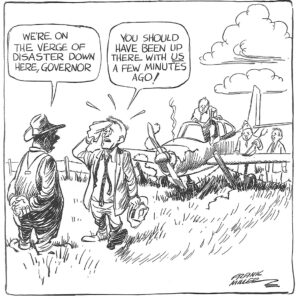
© Frank Miller / Des Moines Register via Imagn Images. July 28, 1956
The view from the left seat
That tradition runs straight through this year’s race. Zach Lahn is a licensed pilot who has been at the controls since he was young. He regularly flies his own plane between homes in Kansas and Iowa. When asked by a reporter whether he’d give up personal flying if elected governor, he said he hadn’t really thought about it.
It also runs straight back to Governor Leo Hoegh, and a cartoon Frank Miller drew in the summer of 1956, during the thick of Hoegh’s tough re-election campaign, the one he’d go on to lose that November.
Miller’s cartoon, headlined “Plane Carrying Governor Hoegh Runs Out of Gas,” shows a small plane down in a farm field, propeller bent against a fence, with Hoegh safely out, approaching a farmer in overalls. The farmer’s line could run in tomorrow’s paper without changing a word:
“We’re on the verge of disaster down here, Governor.”
And the reply from the cockpit experience, equally reusable 70 years later:
“You should have been up there with us a few minutes ago.”
Swap the attire and the decades, and it’s not difficult to see Zach Lahn standing in that field instead of Leo Hoegh — a pilot-candidate climbing down out of his plane, mildly rattled by his own adventure, while the farmer on the ground is worried about the real disaster.
Final approach
Governor Beardsley engineered Iowa’s “farm to market” system — that still uses trucks and trains over highways and railways — to haul Iowa’s bounty to market. His administration created the Road Use Tax Fund and expanded the state patrol with a special focus on safety. He lost his life on one of the highways he worked so hard to improve. It was a cruel irony.
Nearly 75 years later, Iowa is watching another candidate who prefers the left seat. Whether Mr. Lahn’s flights become a campaign footnote or another chapter in that history remains to be seen.
Iowans don’t seem to mind their officials getting off the ground. What draws attention is what happens to their judgment once they’re airborne — whether they disclose the purpose, answer for the fuel bill, account for the hard landing, or forget there’s a countryside of Iowans beneath them, many with real disasters going on.
Most Iowans can handle a politician who’s aloft — as long as they’re not aloof about it. ♦
James Strohman is a Des Moines writer at CrossingBridgesAhead.com.