
Nolan’s ‘The Odyssey’ delivers an epic journey with surprising emotional depth
8/5/2026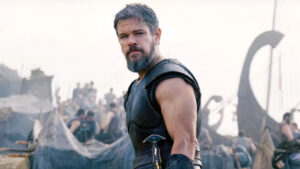
“The Odyssey”
R | 2 hours, 53 minutes
Director: Christopher Nolan
Writer: Christopher Nolan, Homer
Stars: Matt Damon, Tom Holland, Anne Hathaway
Christopher Nolan’s “The Odyssey” places audiences alongside Odysseus and his exhausted crew from its opening moments. You do not simply watch their voyage — you feel it. Every hard-earned victory comes with another loss. Every clever escape demands another sacrifice. When Odysseus begins questioning the cost of every decision he has made, the audience is right there with him.
This is not another swords-and-sandals epic or a straightforward retelling of Homer’s poem. Instead, Nolan transforms one of literature’s oldest oral traditions into a sonic spectacle that rattles theater seats while presenting an intimate meditation on guilt, leadership and survival. Every mile closer to Ithaca raises the same difficult question: What happens when the person returning home is not the same person who left?
Odysseus is not portrayed as an untouchable hero blessed with divine certainty or simply as a fearless warrior destined to overcome impossible odds. Instead, he is presented as something far more compelling: a man burdened by responsibility.
The war has finally ended, and every member of his crew longs to return home. To survive the journey, Odysseus makes decisions that gradually force him to abandon the principles that once defined him. He follows plans requiring terrible acts, watches loyal men pay the price for his choices and slowly realizes that every mile closer to Ithaca comes at the cost of becoming someone he barely recognizes.

Rather than asking whether Odysseus can survive monsters and gods, Nolan asks whether he can survive becoming someone he never wanted to be. The mythical creatures and supernatural encounters are spectacular, but they are never the point. The real conflict is internal. The film continually asks whether a man can truly return home after war has fundamentally changed him.
The story also reminds viewers that Odysseus’ journey is not his alone.
While he struggles across the sea, Penelope (Anne Hathaway) and Telemachus (Tom Holland) fight battles of their own in Ithaca, trying to preserve a kingdom that is beginning to lose hope. Their perspective gives the film emotional balance, reminding audiences that the cost of war is measured not only in lives lost on distant battlefields but also in the years stolen from families waiting for loved ones to return.
The production is extraordinary. Cinematographer Hoyte van Hoytema consistently captures grand scale without sacrificing intimacy. Massive sets tower over the characters, reinforcing the sense that ordinary mortals struggle beneath the watchful gaze of gods.
The sound design is equally remarkable. Rather than merely supporting the action, sound becomes another storyteller. Every crack of thunder shakes the auditorium. Every clash of steel carries weight. Groaning ships, crashing waves and haunting echoes immerse audiences in a world that feels both ancient and immediate.
One sequence demonstrates those creative choices at their best: the encounter with the Cyclops. Visually, it is astonishing. Sonically, it is unforgettable. The creature’s howl is unlike anything I have experienced in a theater, simultaneously terrifying and strangely heartbreaking. Nolan even complicates the audience’s sympathies. Rather than presenting the Cyclops as a simple monster, he invites viewers to consider the creature’s perspective. Its confusion and fury make it feel less like an unstoppable beast than a frightened child reacting to something it does not understand.
The performances deserve equal praise. This is one of those rare ensemble casts in which singling out individuals almost feels unfair because everyone contributes to the film’s remarkable cohesion.
Rather than celebrating conquest, Nolan understands that “The Odyssey” has endured for nearly 3,000 years not because of its mythical creatures or impossible adventures, but because it asks timeless questions: What do we owe the people who trust us? Can we escape the consequences of our actions? After everything we have done to survive, can we still find our way home? By the time Odysseus reaches Ithaca, audiences understand that returning is not the same as recovering. n