
Don’t trash your tech
8/5/2026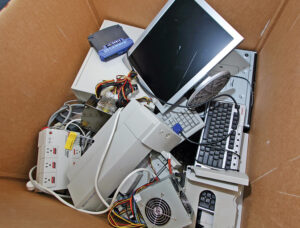
Old electronics are donated to Metro Waste Authority. Photo courtesy of Metro Waste Authority.
When it’s time for small businesses in the Des Moines area to upgrade their technology, what should they do with their old electronics?
The answer is not to throw them away.
Electronics do not belong in landfills, and the sensitive data stored on the hardware should never end up in someone else’s hands. Knowing how to properly dispose of both electronic devices and the information they hold is critical to protecting businesses and the environment.
Many people believe that deleting files or performing a factory reset removes data from their devices. However, that information — customer records, health information, financial data and passwords — can stay on the drive and be easily recovered, Paul Schwegler, founder of Electronic Asset Security, said.

When it comes to proper data destruction, identity theft is a major concern.
“Think about identity theft on a personal level, now figure on a corporate level of what you’re about to lose,” Metro Waste Authority CEO Michael McCoy said. “Say you’re a small insurance agent and you have 500 clients, now I have all 500 clients’ information.”
“In January 2025, the Iowa Consumer Data Protection Act took effect, Iowa’s own consumer privacy law. Now, it’s not only businesses under federal industry rules paying close attention to data destruction,” Schwegler said.
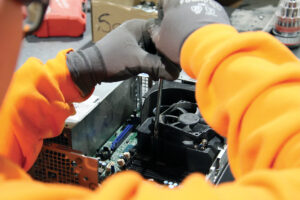
Goodwill employees handle donated electronics. Photo courtesy of Goodwill of Central Iowa
The act applies to businesses based on how much personal data they handle, rather than the industry they’re in, to make sure data is properly destroyed when disposing of old equipment. A business can be fined significantly if the data is not disposed of properly under the act.
“There is a straightforward financial reason to handle it correctly, and beyond that it is simply good practice,” Schwegler said.
McCoy said the first step to responsibly disposing of hardware is to determine what to do with the data stored on the device and how to destroy it.
“There are a lot of parts inside a computer that hold data, not just the hard drive,” McCoy said, mentioning the motherboard, SD cards, memory sticks and the random access memory (RAM). “So, unless you dispose of it properly, you’re going to expose a lot of your private information by not getting rid of it.”
Businesses that are not sure where to begin can contact Metro Waste Authority, a recycling and disposal service for the Des Moines Metropolitan area, to start the process.
“If you’re a small business, call us. We’ll walk you through it,” McCoy said.
Metro Waste Authority recommends securely disposing of the data on hardware before donating electronic devices to them or other recycling facilities and not just going through a light deletion of files.
“Metro Waste Authority does not currently provide data destruction services, although it’s something they’ll look at in the future,” McCoy said. “Instead, they expect its third-party buyers to provide secure data destruction.”
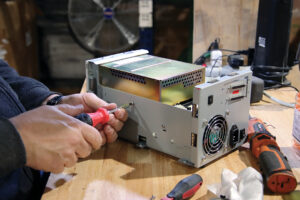
Goodwill of Central Iowa accepts old electronics that will either be refurbished for a second life or responsibly recycled. Photo courtesy of Goodwill of Central Iowa
It is possible for a business to do data destruction on their own. There are information and instructions widely available online and can be found through artificial intelligence tools. However, businesses that need guaranteed secure data destruction should work with a company in the area that specializes in data destruction.
“That’s our advice to businesses and residents,” Kayla Burkett, Metro Waste Authority’s vice president of public affairs, said. “Before you donate or recycle your device, make sure you are doing your due diligence to clear your memory and data.”
Once electronics are donated to Metro Waste Authority, they will break down the device and sell it to third party buyers. Data-storage components, such as a hard drive and the motherboard, are sent to companies that guarantee secure data deconstruction
“You’re basically donating that equipment to us,” McCoy said. “I say you’re donating it because we’ll look at it to see if it can be refurbished or if it simply needs to be torn down into individual parts and then recycled.”
Electronic Asset Security, Iowa’s only R2v3-Certified electronics recycler, provides both data destruction and electronic recycling services to the Des Moines area. They use NIST 800-88-aligned data destruction for proper media sanitization and physical destruction. NIST 800-88, now on Revision 2, published by the United States National Institute of Standards and Technology, is the current globally recognized data destruction standard.
“Data erasure removes the data so the original information can no longer be read, while leaving the device intact and reusable,” Schwegler said.
The Department of Defense method, a multi-pass DoD wipe, is now considered outdated and has been removed from the federal manual.
When wiping the data isn’t enough, Electronic Asset Security will shred the physical device, ensuring the data is irrecoverable. It’s important to know what size to shred the media, because one size does not fit all.
“Our shredder reduces mechanical hard drives to three-quarter-inch pieces, which is appropriate for a platter drive,” Schwegler said, but solid state drives require a three-eighths of an inch shred because the memory chip is only about half an inch. “A vendor that runs SSDs through a hard-drive shredder is not really destroying the data on them.
Schwegler said another method being advertised as a complete data destruction solution is degaussing, where a strong magnetic field erases magnetic media. He does not recommend relying on it for guaranteed data destruction, though it can work on a mechanical hard drive, it doesn’t work on a solid state drive.
“Our focus starts with the data and follows the hardware all the way to its end state, with documentation at each step,” Schwegler said.
Devices that are wiped and used for a second life are checked a second time through an independent system to guarantee that the data was properly destroyed, and when a business requires that their devices be physically destroyed, Electronic Asset Security does just that.
Some equipment is resold to their sister company, Little Dog Tech, after being tested and refurbished.
“For businesses, we also buy back certain equipment that still holds value, generally newer machines, either as a credit toward services or as a payment, handled case by case,” Schwegler said.
Little Dog Tech, a computer repair company in West Des Moines, provides electronic recycling services, accepting electronics such as computers, monitors, switches, flash drives, televisions, printers and more. A comprehensive list can be found on their website.
Through their partnership, Little Dog Tech will take in the waste and send it over to Electronic Asset Security.
“We’re really close with the company,” James White, the lead commercial technician at Little Dog Tech, said. “Electronic Asset Security refurbishes them and then we buy them in a refurbished state from Electronic Asset Security, and then we sell them.”
The rest is recycled with partners that are R2v3 certified, requiring Electronic Asset Security to prove where the materials end up.
To utilize Electronic Asset Security’s services, a business can call, email or submit a request through their website.
Goodwill of Central Iowa also accepts used electronics and provides secure disposal of data before recycling or resale.
“Protecting confidential information is a critical part of responsible electronic recycling, and we take that responsibility seriously,” according to Goodwill’s electronic recycling documentation. “Whether your equipment is prepared for reuse or responsibly recycled, you can be confident that your data will be handled using secure, documented processes.”
Goodwill uses the KillDisk Industrial Sanitization System to permanently delete information. According to Goodwill, this system supports HDD and SSD media, erases multiple drives, utilizes U.S. DoD 5220.22-M erasure standards along with other international sanitization standards, makes data unrecoverable by permanently destroying it, supports SATA, SAS, NVMe, M.2, USB-connected and provides secure and documented data destruction before resale.
Goodwill has partnered with First America, an electronic recycling provider, to handle electronics that cannot be refurbished and resold. First America is responsible for making sure the electronics donated go through a certified data destruction process before recycling its materials.
According to Goodwill, First America is certified in ISO 9001: Quality Management Systems, ISO 14002: Environmental Management Systems, ISO 45001: Occupational Health and Safety Management Systems and HIPAA-compliant data handling practices, all industry-recognized.
Jonathan Henson, director of retail operations at Goodwill of Central Iowa, said any Goodwill location will accept electronic waste items. However, the organization cannot accept console televisions and monitors.
There are key steps to proper hardware disposal: secure data destruction, environmentally responsible recycling, value recovery through resale, donation and value resale on rare earth elements.
“Globally, electronic waste contains about $91 billion worth of recoverable metals,” McCoy said. However, according to the United Nations, that wealth is dissipated because less than 25% of global electronic waste is properly recycled. Global electronic waste was projected to reach 65.3 million metric tons in 2025.
Many of the materials inside electronics are rare and valuable metals that can be recycled.
“Why not gather what we already have?” McCoy said.
“We have to protect our landfill place,” McCoy said. “And one step in doing so is not letting electronic waste go there. If it’s not disposed of properly, then what’s inside the electronics can leach into drinking and ground water.” ♦