
Small businesses turn to AI
5/6/2026While the technology continues to evolve, many entrepreneurs say its greatest value lies not in replacing human work but in creating more space for it.
AI in any industry
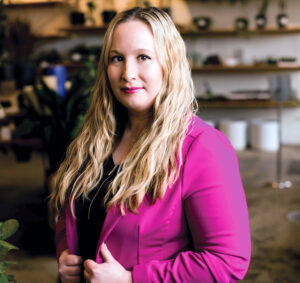
Riana LeJeune, owner of Repinned.
AI can be incorporated into just about any small business — even an upholstery business.
At Repinned, Riana LeJeune’s upholstery business, AI helps streamline proposals, client communication and project planning so the team can stay focused on craftsmanship and execution.
But the real transformation is happening through Renewabl, LeJeune’s platform for visualization and lead generation built specifically for upholsterers, workrooms and soft-furnishing professionals.
In the app, AI is used to create photorealistic visualizations of furniture so clients can see what their piece will become before committing. It removes uncertainty and builds confidence in the decision-making process, LeJeune said.
“I built Renewabl because nothing else existed that truly understood our industry,” she said. “Most AI tools can generate a pretty image, but they don’t understand furniture anatomy, seam placement or how materials behave in real life.”
Renewabl aims to solve that.
“Upholstery is a centuries-old skilled trade that’s been quietly neglected for decades,” LeJeune said. “At the same time, we’re discarding millions of pieces of furniture every year that were built to last.”
She saw a gap between imagination and action. People could not always visualize the potential of what they already had, so they defaulted to buying new.
“With my background in psychology, I understand how people make decisions, and visualization plays a huge role in that,” LeJeune said. “AI gave me a way to bridge that gap, so I took it upon myself to combine my expertise in upholstery with AI to build Renewabl.”
For upholstery shops globally, LeJeune believes AI is solving a much bigger problem. At a larger scale, it is about creating a circular ecosystem.
“When people can see the potential in what they already own — or what they find secondhand — they’re more likely to restore rather than replace,” she said. “That supports skilled trades, reduces waste and keeps quality furniture in circulation longer.”
She does not see AI replacing trades like hers.
“I see it bringing visibility back to them,” LeJeune said. “And that visibility creates opportunity — for artisans, for small businesses and for the next generation entering the skilled trades.”
Using AI as a tool

Abby Martinez, owner of Well Balanced Business
“AI is a tool. A powerful one, but still a tool,” said Abby Martinez, owner of Well Balanced Business, which specializes in providing virtual assistant and operational behavior management services.
“The heart of every business is people, and the businesses that will thrive in this next chapter are the ones that use AI to become more human, not less,” she said.
In practice, Martinez and her team use AI as a behind-the-scenes partner. It helps with the heavy lifting on tasks like drafting SOPs, organizing research, pulling action items from meetings and keeping projects moving. That means the OBMs and VAs are not buried in administrative work.
“They’re freed up to think strategically, catch the nuances and have real conversations with the founders we support,” Martinez said. “AI handles the mechanics so our people can handle the relationships.”
Martinez decided to implement AI after noticing her team was spending its best energy on tasks that were not the reason they got into the work.
“When I realized AI could absorb some of that behind-the-scenes work, it was not about speed for speed’s sake,” she said. “It was about protecting the human parts of what we do — the strategic thinking, the relationship building, the creative problem-solving for our clients. That is what I wanted more of, and AI helped make room for it.”
Claude is the AI tool Martinez and her team return to daily. What she appreciates about it is its ability to understand nuance and tone — something especially important in a people-first business.
On the flip side, the biggest risk she sees is people using AI to replace human connection instead of support it.
“You can tell when a message was written by someone who actually cares versus something that was automated and sent without thought,” Martinez said. “Our clients can feel that too, so we’re really intentional.”
Ultimately, AI has given Martinez and her team something unexpected: their attention back.
“AI did not make our business more efficient so we could do more work,” she said. “It made our business more human so we could do better work.”
Martinez added that she thinks the future is less about what AI can do and more about what it frees humans to do. That idea also shapes Kinflow, her other company — a business operating system built on GoHighLevel that gives coaches and service providers the systems and automation they need to run their businesses without losing the human touch.
“My goal is to help other entrepreneurs use these tools the same way we do — as a way to protect their humanity, not outsource it,” she said.
AI in the digital world

Ramya Prasad, owner of Tech Stack Digital Solutions
Ramya Prasad, owner of Tech Stack Digital Solutions, a digital marketing agency, uses AI in a number of ways in her day-to-day work. In fact, it has become a core part of how her team operates. They primarily use it to optimize web pages for SEO, create social media content and build automated workflows that keep marketing consistent without constant manual effort.
Prasad has also started creating simple apps to pull keyword insights from platforms like Reddit, giving her team a better understanding of what people are actually searching for and discussing.
One of the most notable implementations, she said, is AI voice on their website, which allows potential clients to interact and get answers at any time, effectively turning their site into a round-the-clock resource.
But what Prasad finds most powerful is how AI is leveling the playing field.
“Small businesses can now access tools and strategies that were once only available to larger companies,” she said.
At the same time, Prasad emphasizes that AI works best when combined with real expertise. It can speed things up and improve efficiency, but the strategy behind it still matters.
“The businesses that will benefit the most are the ones that start using it now, build simple systems around it and stay consistent,” she said.
She also notes that businesses that adapt and begin optimizing for both SEO and AI visibility will be in a stronger position moving forward.
In addition to saving time, another major shift has been using voice agents to handle client inquiries.
“Instead of missing calls or responding late, we now have systems in place that can engage with potential clients right away,” Prasad said. “This helps us capture more opportunities while also improving the overall client experience.”
Because of this, Prasad’s team is no longer spending most of its time on backend execution, but instead focusing on overarching strategies to move both the business and its clients forward.
She acknowledges there are still challenges. One of the biggest is that AI can sound very confident even when the information is not fully accurate. Relying on it without review can lead to content that feels generic or slightly off.
There is also the pace of change.
“New AI tools are being released almost every day, and it can quickly become overwhelming,” Prasad said. “It is easy to fall into the trap of constantly trying new tools instead of actually using what works. We have learned to be intentional about this. Instead of chasing every new tool, we focus on selecting the ones that truly improve our efficiency and results, and we avoid unnecessary distractions.”
Overall, Prasad believes AI is opening up new opportunities for small businesses.
“In the past, a lot of advanced marketing tools and strategies were only available to larger companies with bigger budgets,” she said.
Things like SEO content at scale, automation, customer follow-ups and data insights often required a full team or expensive software. Now, with AI, a small business owner can accomplish much of that without needing a large team.
“You can create content, respond to leads faster, automate follow-ups and stay consistent with your marketing without feeling overwhelmed,” she said. “It removes a lot of the barriers that used to slow small businesses down.”
At the end of the day, Prasad said, AI is not replacing small businesses.
“It is giving them tools to operate smarter, move faster and grow in ways that were not easily possible before.” ♦