
Jesse Jackson was a rural Iowan as much as any of us
3/4/2026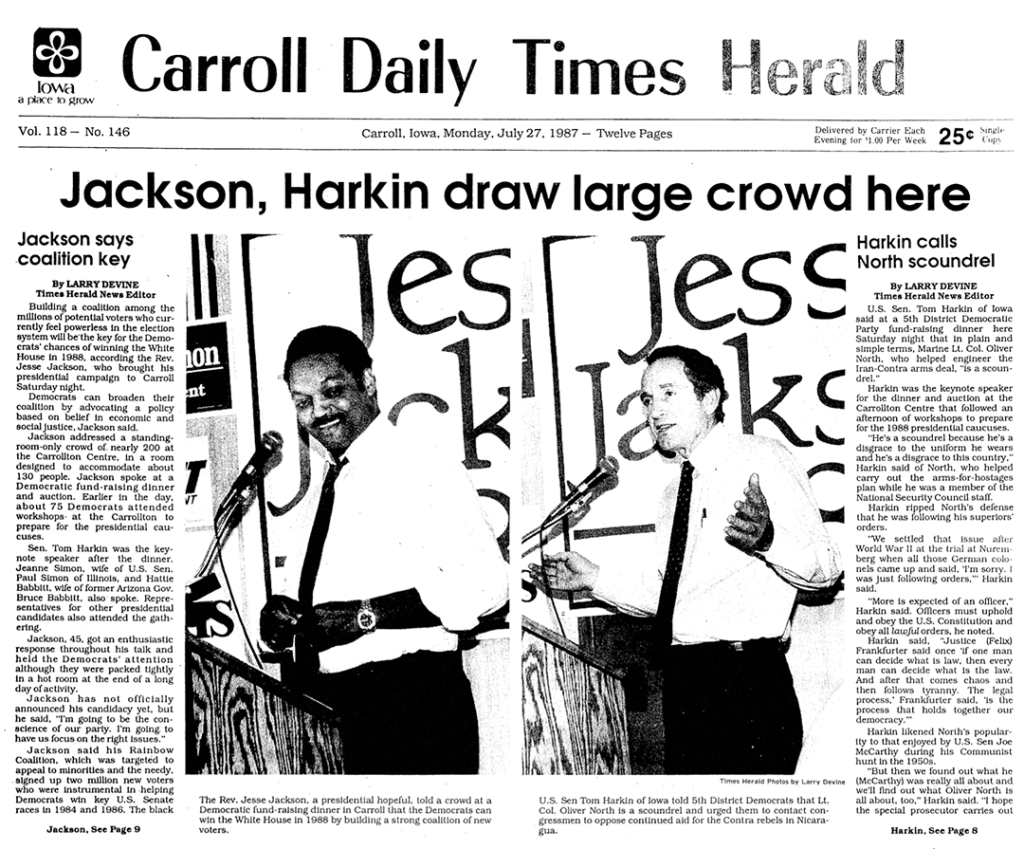 Speaker of The House Mike Johnson is just wrong on his decision to deny a request from the family of the late civil rights leader and presidential candidate Jesse Jackson to lie in honor in the U.S. Capitol.
Historical precedents swing both ways on this. Dick Cheney and Charlie Kirk didn’t lie in honor. Billy Graham and Rosa Parks did.
I’m not going to speculate about the motivation for Johnson’s decision. It’s defensible, but misguided. Just wrong.
Jackson surely deserves the honor. Speaker Johnson should reconsider.
I say this as a rural Iowan and a former owner of the Adair County Free Press newspaper in Greenfield, the small town that Jesse Jackson, in a remarkable connection, a singular one for a presidential candidate, selected as the Iowa headquarters for his Oval Office bid in 1988.

Think of that — from the perspective of 40 years ago, no less: As a major-party candidate, Jackson tabbed a rural community instead of Des Moines as the central hub of his historic campaign in the first-in-the-nation testing ground.
Iowans — and the nation — quickly learned why as Jackson actualized what Robert F. Kennedy had dreamed of 20 years earlier in Kennedy’s own effort to mobilize a rural-urban, multi-racial coalition.
The connections Jackson created between rural and metro Iowans are perhaps only rivaled in the history of the state by the existence of Buxton, a now ghosted city that thrived in the early 20th century with the inclusive spirit that powered Jackson’s campaign.
Yes, Jesse Jackson is a South Carolinian. He’s a Chicagoan, a former D.C. senator. He’s also an Iowan — and a rural Iowan at that. In other words, he’s one of us.
Last spring, I sat next to Jesse Jackson’s son, Congressman Jonathan Jackson, D-Illinois, at a dinner at St. Anselm in Washington, D.C. for three hours. We talked for much of that time about Iowa — about his father’s love of our state, and we brainstormed about how to greater recognize and honor the connection.
Our family, four generations deep in Iowa journalism, didn’t own the Adair County Free Press during Jackson’s bids for the presidency in 1984 and 1988. The Free Press was in its own historic hands with the Sidey Family at the time. Our family was at the flagship newspaper in Carroll, and I was in high school, during Jackson’s campaign visits to Iowa.
He was the first presidential candidate I spoke with in person, and later, the first I interviewed as a reporter.
Most important, I watched intently, taking in every detail, as our long-time editor at the Carroll Daily Times Herald, Larry Devine, my mentor and dear friend, skillfully interviewed Jackson in July 1987. Larry was exceptionally well prepared for that interview and coverage, and it shows 39 years later in a re-reading of the story.
Watching the interview formed a foundation for me and showcased this truism in journalism, one I would share with later generations of reporters: the way to earn respect from a source, whether a presidential candidate or a small business owner or a teacher, is to show them the respect of being well prepared. Larry was certainly that for the Jackson visit.
From my perspective, imagine this: one of the first presidential stump speeches I heard in person, perched in the front row of a conference room at the Carrollton Inn, was from Jesse Jackson.
Had I entered the Carrollton Inn that night with any conflict or ambiguity about my future, such feelings quickly coalesced around active ambition for a career in politics and journalism.
Later, in college, as a reporter for The Daily Northwestern, I would interview Jesse Jackson at the Inland Newspaper Convention at the Drake Hotel in downtown Chicago. I know we talked about urgent issues of the day, but all I can remember now is that he spoke with me about rural Iowa, about Greenfield specifically, and people there, many of whom he named.
His love for Iowa came through. I can still feel it all these years later.
Reverend Jackson didn’t build a residence in rural Iowa. He built presidential campaigns.
He has what I will call “earned residency.” Jesse Jackson is an Iowan. A rural Iowan.
And we should be able to mourn one of our own in the nation’s capitol.♦
Douglas Burns of Carroll is fourth-generation journalist and founder of Mercury Boost, a marketing and public relations company.