
Thieves, cons and native roots
2/4/2026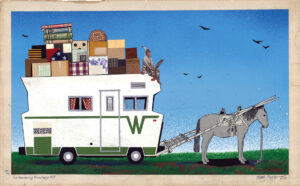
Henry Payer’s “The Wandering Winnebago.” Courtesy Des Moines Art Center
The juiciest story in the art world last month was that of Thomas Doyle, a Kansas-born con man who has been arrested numerous times under at least five different names. Wall Street Journal’s Jenny Strasburg catapulted Doyle to the big time as far as infamy goes telling how he conned a revered London art dealer and Bruce Springsteen’s long time manager Jon Landau over “Portrait of a Girl” by Jean-Baptiste-Camille Corot.
Landau was a Rolling Stone reporter in the early 1970s when he wrote, “I have seen the future of rock & roll, and his name is Bruce Springsteen.” Then he quit his job and became The Boss’ manager. He bought the Corot masterpiece from Doyle, although he had turned it down several times before. Doyle sold it for a super bargain price, about an eighth of its value. You get what you pay for.
Doyle planned a getaway by sending the dealer, who was never paid, a confession stating he planned to “turn on the Moody Blues, open a bottle of bourbon and eat my 1911 acp for dessert,” referring to a semiautomatic pistol long used by the U.S. military. In truth, Doyle was arrested in Connecticut, where he had been living for weeks out of his car in a hotel parking lot.

Henry Payer’s “Seventh Generation Winnebago.” Courtesy Des Moines Art Center

As a Midwest chauvinist, our favorite story was that of the elite media discovering the awe-inspiring Anselm Kieffer exhibition “Becoming the Sea” in St. Louis. Even CBS did features on it, and it usually takes an act of God to get them to recognize anything that originates anywhere between the American coasts. Kieffer hung seven 30-feet-tall paintings, made with lead and ash, of the Mississippi and Rhine rivers in the St. Louis Museum of Art. It was a grand show that reminded even New York critics that the Gateway to America is more than an arch.
Locally, the big story was that Hoyt Sherman Theater’s age-appropriate pipe organ, a gift from the Maloof brothers (owners of the Sacramento Kings and The Palms hotel-casino in Las Vegas), will cost $187,000 to install. That’s nearly $60,000 more than Landau paid for his stolen masterpiece.
Touts
February brings Des Moines two art events that also reflect historic times. Edgaard Camacho is a French-born Venezuelan whose journalistic and artistic works have forced him into exile in Des Moines. The depiction of a mass murder, seen by the artist, caught the interest of the Venezuelan National Cultural Center early this century. He was called to be part of “La Megaexposición: The Best of Venezuelan Art of the 21st Century.” By the time that touring national art show took place, he had already found exile to the United States.
Close ties to Maharishi University, University of Iowa and Iowa State University brought him to Des Moines. Camacho is versatile, creating everything corporate logos to street life drawings. His show at Moberg is that gallery’s first with Steven Vail as curator. Vail deals with international artists of renown. The partnership with Moberg gives his artist a local presence that should be good for both Moberg and Vail. There may be more to follow as Moberg and Vail contemplate a more permanent partnership.
Des Moines Art Center launched an exhibition of Henry Payer, a Ho Chunk (white man’s name — Winnebago) mixed media artist who seriously explores his native and post-appropriation roots in “Aagakinąk Haciwi: We Live Opposite Each Other.”
This show, through June 17, is rife with delightful ironies and anachronisms. For instance, Payer likes to work on ledger paper, which was introduced to the Ho Chunk with their census, monetary transactions with the U.S. government, and even as legal tender. That gives Payer’s surname an irony of historic proportions.
Payer also has considerable fun exploring ironic takes on the Iowa recreational vehicle company that shares the name given to the Ho Chunk, most likely on ledger paper. ♦
Jim Duncan is a food and art writer who has been covering the central Iowa scene for more than five decades.