
Respite — Places that restore our resilience
12/31/2025We reached out to the staff of Iowa Architect, the official magazine of The American Institute of Architects, Iowa Chapter, and requested permission to reprint portions of their cover story, Respite: Places That Restore Our Resilience, from their summer 2025 edition. In it, they featured projects by Iowa architects that truly do offer respite and that are places that restore our resilience. We appreciated the projects and the stories, and we thought you would, too.
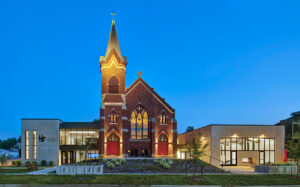
RECONNECTED: LUTHER MEMORIAL CHURCH
Words: Grant Nordby, AIA | Images: Cameron Campbell, AIA, Integrated Studio | Architect: Slingshot Architecture
The sanctuary of Luther Memorial Church was built by Danish American craftsmen in 1918 to commemorate the 400th anniversary of Martin Luther’s famous 95 Theses. Ever since, the building has served as a focus of the local Danish community, and it functions as the de facto “campus church” of nearby Grand View University. More than 100 years later, the church recognized a need for more inviting spaces to reconnect it with the campus and community. They turned to Slingshot Architecture for solutions.
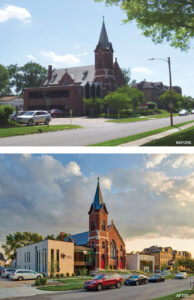 There were numerous challenges. Principal David Voss, AIA, explains that the roofline of a gloomy 1950s-era addition had been “built up against the (sanctuary’s) existing stained glass windows.” It also decidedly lacked welcoming curb appeal. The basement community room was typical of many found across the Midwest: dark, dull and spartan. A gently inviting entry sequence and indoor/outdoor gathering spaces were sorely needed to extend spiritual and community life beyond liturgy and into people’s daily walk. But how to find space on the crowded site, hemmed in by surface parking and neighboring structures?
A new at-grade fellowship hall now mirrors the 1950s footprint, buffered from the taller original sanctuary by dark-clad, receding forms. This addition allowed for classrooms to relocate to the sanctuary basement. The 1950s addition was demolished, replaced by new construction of approximately the same volume but radically different in feel — now offering a series of transformational welcoming spaces. A generous, daylit entrance now leads to a two-story, skylit lounge, augmented by service spaces and a sanctuary-level nursery for wrangling young children during worship services. Once cozily settled, visitors turn up an ample stair to find themselves on a “bridge” spanning the entrance and taking them into the sanctuary. This has been restored to its original splendor, handcrafted woodwork gleaming in the light of restored and unobstructed stained-glass windows.

The new fellowship hall is heavily used by the community, fulfilling its mission of welcoming others. Its indoor/outdoor fireplace is surrounded by large windows, giving expansive views in both directions. These invite passersby inward via the commodious new outdoor terrace, and they prompt churchgoers to gather visibly in purposefully porous public spaces. This public-facing elevation aligns with the Beaux-Arts entrance of the imposing Humphrey Center (campus administration) across Grandview Avenue, to which it is explicitly linked by an ample walkway. New exterior lighting illuminates the sanctuary like a beacon at night, while the modest, welcoming embrace of the fellowship hall and main entrance invite the curious in through glowing glass walls.
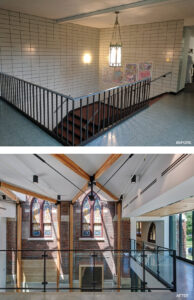 The concept of warm, welcoming Hygge — a Danish term conveying ideas of comfort and close-knit community — consciously extends to the materials used. Restored woodwork celebrates original Danish American craftsmanship, while the additions continue the tradition in modernist Scandinavian fashion through wood accents and timber compression members. The latter pair with black steel tension rods in soaring “V” forms, mirroring the Gothic arches of the sanctuary. In strategic locations, these cradle skylights give light to both the original stained glass and to spaces below — an elegant re-knitting of new and old into more perfect unity. The timbers also nod to the Danish shipwright tradition, the sanctuary’s vessel-like analogue made explicit in the restored model of a sailing vessel on display in the sanctuary. Modern methods extend and renew historic ones, relinking churchgoers to their roots while embracing new growth.
The additions’ exterior forms are purposefully modest, and their materials are natural — appearing “quiet, clear and honest,” in Voss’ words. But these simple forms give way to joyfully daylit structural gymnastics indoors — their understated Scandinavian warmth half-concealed, half-revealed. Materials in the new spaces are organized in simple, clean forms washed by daylight, conveying a sense of calm yet convivial well-being.
This well serves the needs of churchgoers and visitors who come in search of comfort, community, and spiritual connection. Here, they find respite from the stresses of life, affording time and space to process vicissitudes and restore their spirit in the warm fellowship of friends.
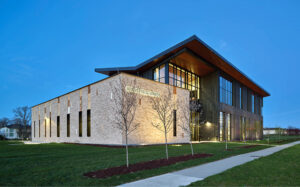 GRIMES PUBLIC LIBRARY: NURTURING COMMUNITY
WORDS: Mircea Nastase, Assoc. AIA | IMAGES : Cameron Campbell, AIA, Integrated Studio | ARCHITECT: INVISION
From the earliest Carnegie libraries dotting the state to the modern civic centers of today, Iowa’s public libraries have continued to transition alongside their communities. These spaces are not only for learning but for gathering and pausing amid the rush of life. The Grimes Public Library embodies this role, positioning itself not just as a storehouse of books but as a shared space for its community. In this space, knowledge, refuge and connection intertwine.
Positioned at the intersection of homes and schools, the library is a natural hub for the rhythms of daily life. A bike path winds past its entrance, drawing in families, students and neighbors who see it not as a destination but as a part of their everyday landscape.
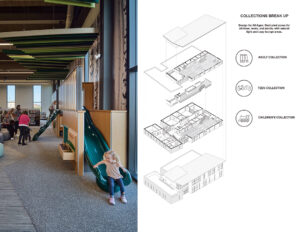 “Libraries are a fundamental piece of a city’s social infrastructure and therefore should be designed for all members of the community, ” shares Grimes Public Library Director Cheryl Heid. The Grimes Public Library does just that. Here, a child stops on the way home from school to grab a new adventure, a retiree finds a place to linger over the morning paper, and a young professional escapes for a moment of quiet before returning to the rush of work. The library belongs to them all.
Originally designed at 31,000 square feet to accommodate this growing community, budget considerations led to a more modest 22,500-square-foot facility. Embracing this challenge, INVISION carefully designed the site and massing to ensure future expansion(s) to the public areas will be seamless, allowing the library to grow without disrupting existing operations.
The exterior of the building is divided into two main areas: a limestone and brick single-story private operations section that grounds the structure in history — recalling the solid, enduring materials that have long defined the Midwest — and a larger mass clad in contemporary black metal panels to contrast from the single-story mass and signify the main public space. Tying both masses together is a linear motif derived from the rhythm of book spines, expressed in narrow windows and metal panel patterns. The larger public collections’ mass is topped with the building’s most distinctive architectural gesture — the library’s roof, shaped to evoke the character of an open book. What began as a pragmatic solution to conceal the elevator overrun evolved into a signature design feature, dignifying the main entry into the building while solving various design challenges.
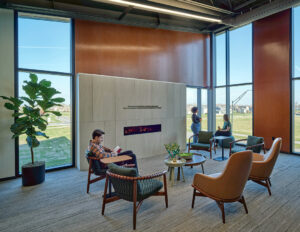 Upon arrival, one will notice a break from the “traditional” library experience. A new model embraces an open, engaging, and often loud atmosphere emphasizing interaction and inclusivity. The library incorporates playful and interactive elements such as a small playground and hands-on activity stations, creating diverse spaces for all people. With three distinct areas — including a two-story collection space, a single- story administrative wing and public meeting spaces — the building offers diverse programming opportunities, with the lower level of the main collection space dedicated to children, a mezzanine level for teens, and a quieter second floor housing the adult collection. Even when the main collections area is securely closed for the day, a strategic layout allows public spaces to remain open after regular library hours, reinforcing the library’s role as a true community hub that is accessible whenever needed.
The Grimes Public Library serves as the “living room” of the city. A welcoming space that fosters connection, nourishment, and growth through warm materials, soft seating, and intimate reading nooks that contribute to a sense of familiarity. An entry art piece, highlighting the donors who made the building a reality, embodies this notion by drawing a parallel between the deep roots of native prairie grasses — which quietly anchor the soil and shelter fragile life — to how libraries provide a protective environment where young minds can nourish and grow. Architecturally, the library embraces this mode with materials that echo the intimacy of the home through wood-inspired panels, soft seating and spaces designed for gatherings. A centerpiece of this effort is the second-floor fireplace, where the flicker of an electric fire and the simulated sound of crackling embers provide a moment of pause. Here, a visitor can settle in with a book, wrapped in the quiet glow of a space that feels both public and deeply personal.
Through a collaborative design process between INVISION, the City of Grimes and library staff, the new facility stands as an example of how public architecture can foster resilience, engagement and renewal. More than just a place for books, the library has become an extension of home, a retreat from the everyday and a welcoming environment for all.
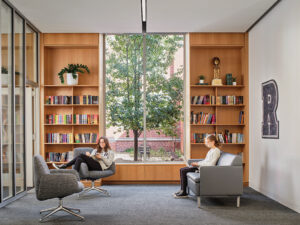
LEARNING REIMAGINED: THEODORE ROOSEVELT LIBRARY
Words : Anna Squier, AIA | Images : Chris Boeke Studio | Architect : Neumann Monson Architects
A library is traditionally defined as a collection of resources, books, magazines and digital media, organized for use by a community for education and research. However, the role and design of libraries have evolved. No longer are libraries just quiet spaces lined with book stacks. Today’s libraries are vibrant, flexible environments that encourage collaboration, exploration and engagement. The renovation of the Theodore Roosevelt High School Library exemplifies this shift. Led by the Roosevelt High School Foundation, the library’s transformation aimed to create a modern learning resource center tailored to diverse learning styles. The project prioritized cutting-edge technology, flexible furniture, daylight and inclusivity to support both individual study and group work.
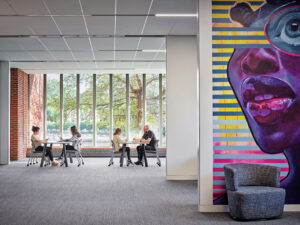 Neumann Monson Architects spearheaded the design, with architect Cheung Chan, AIA (also a parent of Roosevelt students), at the forefront. Chan worked closely with the Roosevelt High School Foundation, Des Moines Public Schools, students, the high school’s principal and consultants to reimagine the library’s role in a modern educational setting. The collaborative process resulted in a contemporary space that challenged the typical role of the library while embracing student culture and values.
Chan shares, “A guiding question throughout was, what role does a library play in a modern school, and how does it support the modern learning style?” Student engagement was key. In workshops, students received floor plans of the existing space and were asked to annotate them with ideas and priorities. This feedback became a visual roadmap that informed multiple design iterations.
“The goal was to integrate all forms of learning into one space,” Chan explains. “We wanted to boost student engagement by creating more opportunities for collaborative study.”
 The result is an open layout with a variety of flexible spaces including conference rooms, group areas, and study nooks, all designed with minimal partitions aligned with reveals in the ceiling that trace the existing building’s structural grid.
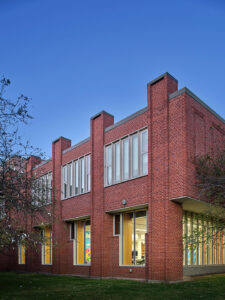
Minimal white partition walls serve as a gallery for curated works by local artists, offering a visual narrative that echoes the community’s depth and diversity. Perimeter walls are activated with built-in bookshelves that reintroduce the role of books in a contemporary spatial experience, anchored by built-in window seating that invites pause and reflection. Expanded clerestory windows introduce abundant daylight and framed views, enriching the spatial quality while subtly augmenting the original elevation’s long vertical lines with tall vertical mullions. This verticality is echoed in the interior storefronts, creating a cohesive architectural language. The interplay of these vertical elements choreographs the movement of light and space, drawing occupants through the depth of the space toward areas of discovery and engagement. At the heart of the library sits the “Rider Bar,” a multifunctional circulation desk that also acts as a charging station and social hub. With a cantilevered design, it invites students to gather, connect and recharge — both figuratively and literally. Accessibility was also a major focus. Existing single-user restrooms were expanded and redesigned to meet modern standards, ensuring barrier-free, inclusive facilities for all students.
The renovated Roosevelt Library is more than just a place for books. It is a thoughtfully designed, student-centered environment that supports modern education through innovation, inclusivity, and collaboration. According to Chan, “To be able to see the space being utilized, whether in the way intended or not intended, is the most rewarding. Sometimes, unintended is the most exciting.” It is learning reimagined. ♦