
Installation in progress
12/3/2025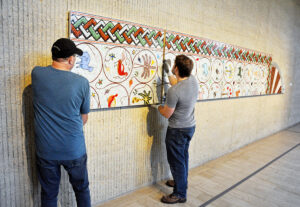
Tom Rosborough and Zachary Quick install Jordan Nassar’s” Bethlehem-In-The-Galilee,” 2025 in the Art Center’s I. M. Pei building.
Established in 1948, the Des Moines Art Center has brought world-famous works of art right into central Iowa’s backyard. Whether it be at an exhibit inside one of the three unique buildings, which are considerable artworks themselves, or the renowned John and Mary Pappajohn Sculpture Park in downtown, the Art Center has made the Hawkeye State’s capital a destination for exceptional artwork.
Its permanent collection contains works from names such as Andy Warhol, Claude Monet, Georgia O’Keeffe and Grant Wood to name a few, and that does not count the various exhibits that make a temporary stay inside its walls.
These names are etched in the memories of art connoisseurs, and their works are taught by art teachers from elementary schools to universities, documented, viewed, preserved and appreciated. What goes under the radar, however, are the people behind the scenes, building the crates used for transporting the works and the mechanisms required to display the art, and helping provide a worthwhile viewing experience so those walking through the Art Center have the most enjoyable experience possible.
Those people are the Art Center’s Installation Department. By their own design, they are unsung and unseen, helping make the Art Center’s exhibits and artwork look pristine and presentable.

The group has more than 100 collective years of experience in the department. Most are practicing artists themselves, helping build the mechanisms for hanging, displaying and lighting the artwork, building the frames to custom dimensions and temperature and moisture restrictions.
The team recently acquired a new leader, Director of Installations Jonathan deLima, who brings 20 years of experience of his own. He takes over for Jay Ewart, who had held the position for 21 years.
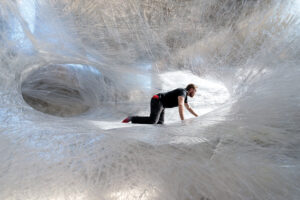
The installations department needed 14 people and two weeks to set up “Drawing in Space” in 2017. Photo by Rich Sanders, courtesy of the Des Moines Art Center
Meet the team
We sat down with several members of the team to find out what they do to bring various works to the eyes of Des Moines. At the time of the interviews, the group was taking down the “Iowa Artists 2025” exhibit by quiltmaker Ben Millett.
“You had the artist here, and so he was overseeing how everything would go up, and we would check in with him as to how he wanted it to look. You have some three-dimensional things that you’re hanging, you’re suspending in this one room here, and then you get two-dimensional things on the wall,” Tom Rosborough, assistant preparator and former illustrator, said.
Rosborough has been working in the installation department since 1999. He says the group often works with the artist or other exhibits to ensure they know ahead of time the best way to install the art.
Mindy Meinders, conservation technician and works on paper coordinator, has roughly 40 years of preparatory work. Some would consider that more than enough to be an expert on the subject.
“Oh, well, I don’t know about that. There’s too much to know for that,” Meinders said.
Meinders, a painter with a studio at the Fitch Building, primarily works with the permanent collection of works on paper.
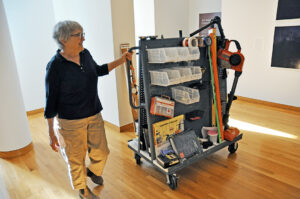
Mindy Meiners guides trusted assistant “Peggy” through the Richard Meier building to help with the installation of artwork
“Anything that needs to be framed or matted (the border of an artwork), I do that but also repair and wash some prints and take care of any problems that might arise with them,” Meinders said.
While that is what she is normally focused on, she does also help with hanging paintings or building as needed. Helping across all areas is a common theme for this group.
Jeff Ashe, lead preparator, has been working with the department on and off for 25 years. Ashe does more of the physical aspects of the job — large-scale rigging, and heavy equipment operation — and takes a liking to the technological and material side.
“I have experience with large machines and things like that, and so I also have a fascination with the exponential magnification of a person’s movements. This often requires a high level of finesse, which makes for operating heavy equipment to move these fragile things. I think to some people, that’s like an undigestible prospect, but for me, I enjoy that aspect quite a bit, because it is the opportunity of a true melding of man and machine to create this thing that ultimately is not an air conditioner on a roof or a new wing on a school. I really enjoy opportunities to make incredibly large objects succumb to our will, through subtle manipulation,” Ashe said.
Michelle Hill, a graphic designer and also a former helicopter mechanic in the military, is an assistant preparer and works on paper coordinator. Hill was in charge of the Ben Millet exhibition that the group was taking down. She has been with the department for two and a half years. She originally joined the team as a security guard.
“I’ve always been kind of naturally mechanically inclined. You need to have some design skills. As a graphic designer, that helped me manage to multitask and certain shows and everything. Being a mom actually helps,” Hill said.
Temporary employee Aida Peña spends time between installations and registration (the process of documenting the artwork’s condition) but first started in the education department in 2019.
Associate Preparator Zachary Quick recently celebrated his eighth anniversary with the installations department.
“I started as a part-time person on a show called ‘Drawing in Space.’ And, then I worked part-time with installations but also with the security for four years until about 2020 when they hired me on full-time,” Quick said.
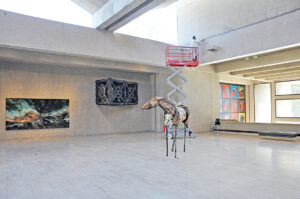
Teresita Fernandez, “Viñales(Chasm),” 2022; Phyllida Barlow, “Untitled: balcony,” 2012; Deborah Butterfield, “Untitled (Hoover),” 1986; Sol Lewitt, “Wall Drawing #601, Forms Derived from a Cube (25 Variations),” 1989
Installations
The “Drawing in Space” exhibit came up more than once when asking the installation team about which exhibits were most challenging. Tape was suspended throughout the Art Center, allowing visitors to crawl through it. The exhibit took a team of 14 people two weeks to set up. Meinders, Rosborough, Quick and Ashe all named that as one of the most taxing exhibits they have worked on.
“We suspended tape through the whole gallery that you could actually walk in. We had to kind of test the strength of the walls,” Rosborough said.
“They had to do load capacities on the wall,” Quick added. “They have to make sure that no one’s going to fall through the tape. That was a pretty difficult, but also very fun, one.”
Hanging artwork is not inherently seen as a dangerous job, but when a project tests the strength of the walls it is inside of, or a large sculpture needs to be hung or set up, the danger is real.
“Anytime we have an object where, if there is a critical failure, somebody’s not going home (is challenging). Sounds dramatic to bring it to that state, but that’s absolutely true. A thousand pounds is a thousand pounds. If something goes wrong, and I’m putting a two-pound painting on the wall, that’s a shame. If something goes wrong and it’s 2,000 pounds, I just lost a friend,” Ashe said.
Another challenging exhibit, according to Rosborough, was by visual artist Phyllida Barlow.
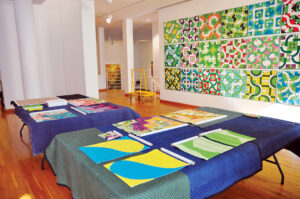
Mindy Meiners guides trusted assistant “Peggy” through the Richard Meier building to help with the installation of artwork
“She basically filled that entire Pei wing (I. M. Pei Building) with pieces that were very heavy. She had a large piece that was called ‘Scree’ that went from the floor all the way up to the ceiling. She brought in a crew, and we worked with that crew in creating her vision. She was there and oversaw the whole thing along with us,” Rosborough said.
Even the amount of light that gets projected onto various artworks is taken into account by the installations department. Certain works require different light levels.
“Light is a big enemy. There have to be considerations into how much UV unfiltered light is hitting these objects. Now, paintings, are generally pretty robust. Works on paper are generally pretty vulnerable. Fabrics are sometimes exceptionally vulnerable, considering the kinds of dyes and processes used in their creation,” Ashe said. “In many cases, when we’re doing an entire show, we put everything up, take all the lights down, and start from scratch and build to meet a level that is the ceiling that we can’t light beyond, and then refine that to give each piece its own prominence and its own presentation.”
Knowing where things should go, how high they should be, and what color should be on the wall behind them are all part of the process.
“The current show we are doing right now, you have a lot of photos. We would have had to paint the gallery after the last show to make sure there were no blemishes on the walls,” Quick said. “To get exactly where it goes, we measure the height of the piece. And then, the baseline is 58 inches, that’s the average human eye level, so that’s where we want the center of the piece to be.”
For the Manuel Álvarez Bravo exhibit, which will be on display until Jan. 18, the installations department did plenty of preparatory work.
“We had 220 pieces. We started in February. Someone went down to Mexico City and measured everything, and we pre-cut all the mats ahead of time, and then we framed them all. That was very time-consuming, but we were ready when the time came to hang them on the walls,” Meinders said.
In Meinders’ work on the permanent collection of works on paper, she walked us through some of her processes.
“A lot of times, you unframe something, and, because of the housing that was previously used, it could be acidic. Regular cardboard is really full of acids and will deteriorate the paper. So, if it is a print with non-soluble inks, you can wash it. It’s a little tricky, but you soak it in distilled water and remove it and then blot it dry with blotter paper,” Meinders said. “The standard museum practice of attaching paper to the backboard is a Japanese handmade paper and wheat paste. And a lot of framers will use linen tape, which is hard to get off, and if the piece were to fall, the artwork would tear. So, we tend to replace that material and try to get off all the adhesives left behind.”
At times, Meinders has been pleasantly surprised, saying a lot of times an artist will paint one side, not like it, and begin on the other side, leaving behind an unfinished work.
The process of bringing pieces in is not always easy. Hill reflects on a time when, in the Pei wing, the team ran into challenges created by a large work by Shechet.
“It looks like a yellow elephant. It came in a giant crate, and so we had to hire equipment to get it in. Then we brought it through the auditorium, and then we couldn’t fit it through the door. We had to take down the fire exit signs in order to get it through. It was just a debacle. We ended up getting it in, and it was more complicated because of how heavy the pieces were and how big the crate that it came in was,” Hill said.
The installation department also prepares the artwork to be transferred to its next destination. This can require them to custom-build crates.
“A lot of times, when the pieces come in, they could be crated in a certain way, or we feel like they’re not protecting the piece in a specific way, we will usually upgrade whatever they have before it goes back out. We usually give them back to them better than what they sent,” Rosborough said.
All in all, the goal for the installation department is for no one to know they exist. To them, if they have done their job correctly, those who attend the Art Center are able to interact with the art as intended — and that reputation follows them.
“Historically, this place has an astonishing record of manifesting quite ambitious and amazing projects. They care a lot about people’s experience and doing good work that helps raise people’s potential experience with the artworks,” deLima said.
The process is harmonious. Between installations, curatorial and registration, all of it comes together to bring these works of art to Des Moines. deLima found an apt comparison.
“If you go into a concert, and it’s too loud, you can’t hear the whole sound because it’s overwhelming. It’s hard to engage with. If it’s too soft, you can’t pick it up. That is the same as light. If it’s too bright, if it’s too dark, that’s kind of self-evident,” deLima said. “You are in an environment that promotes engagement with the work, with the space, potentially even with the other people in the space.
“Like a great restaurant meal or a spectacular, really moving theater experience, you’re aware of being transported, or you feel energized by the experience, and not feeling like you’re paying attention to all of the decision-making, because, hopefully, it all feels part of the whole so you’re not necessarily being pulled out to think about all the separate pieces,” deLima added.
Appreciating the artwork
With most of the team having been working with the Art Center for multiple years, several of the members have interacted with some of the most famous artworks ever seen. As most of them are artists, or at a minimum art appreciators, they appreciate the weight of the art more so than just how much they have to carry.
“It’s always like Christmas morning when you open the crates and you really have no idea what it’s going to be or what condition it’s going to be in. That’s always nice because we all have a love of art,” Meinders said.
A favorite for Meinders, last year, was one of the print exhibits the Art Center hosted for Rembrandt, a famous Dutch painter from the 1600s.
“Eighteen Rembrandts in our paper collection. Handling them is kind of awesome,” Meinders said.
For Hill, it was a Picasso painting, which, as well as working with the current show, gave her an extra appreciation for it.
“I’ve been able to frame Picasso. This current show, his photographs are just gorgeous, and I was able to help coordinate that show. We got to talk to his daughter. Once you know the story, and there’s a connection there, whether it’s with the artist or family, it becomes important, not that it wasn’t already,” Hill said.
Ashe has been able to handle one of the most famous pieces of Iowa art.
“I had the opportunity to work on the installation of the ‘American Gothic,’ which is arguably the second most recognizable painting in the world and hugely important to Midwest Art, to regionalism and to Iowa itself,” Ashe said.
Quick says that not only temporary exhibits but some of the permanent pieces held by the Art Center have given him a sense of awe.
“The John Singer Sargent, or like handling the Picasso. When I was a guard at one point, someone was like, ‘Is that a real Picasso, or is that a print?’ And I had to be like, ‘Well, it’s real,’ ” Quick said.
For Peña, it was a Japanese contemporary artist.
“I was really excited for the Takashi Murakami to come out. I’ve personally never seen that on display. I walked by it in storage a few times, but I was really excited for that to come out,” Peña said.
Working without being seen
“I think that, if we do things right, no one can tell we’ve done anything at all, and the shadow work that we perform is meant to make it all look effortless. So, if it’s belabored, if it’s overdone, if our fingerprint is clearly legible, that’s a shortcoming,” Ashe said.
The work the group does goes unsung and unseen, and that is purposeful, but it does not detract from the time, quality and care that each member of its staff puts into it. Each of them specializes in different works, coming together to bring Des Moines a cultural gem.
deLima, who has only been with the Des Moines Art Center for a short amount of time, said their reputation precedes them.
“That team accomplished some extraordinary things that were noted locally but were also consistently appreciated by the visiting artists and by the people who they worked with,” deLima said. “This team is super resourceful, responsive, nice to work with. I can say all of that because I heard it from other people, and that’s some of the legacy of what that team had brought to the art world that came through here on the installation side.” ♦