
Remembering Bill Knapp
12/3/2025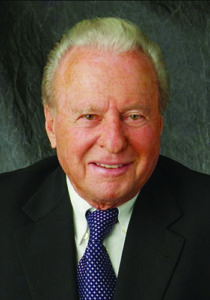
Bill Knapp
One afternoon 50 years or so ago, when I was president of The Des Moines Register and Tribune, Bill Knapp called me.
“What are you doing?” he asked, and before I could answer, he said: “I’m on my way to pick you up. We need to raise $250,000 this afternoon to save Tiny Tots. I’ll explain in the car.”
He explained in the car. Tiny Tots was a nonprofit day-care center on the near-northside run by a wonderful but not very business-savvy woman named Evelyn Davis. It had some rundown space in a former school, and it was deeply in debt, which he had just discovered.
We made the rounds downtown. Knapp explained to a Principal executive that many of these kids came from single-mom families. “If Tiny Tots shuts down,” he said, “the moms stay home to take care of the kids. If the moms stay home, you lose a lot of good workers.” He argued to Dwight Swanson, I think, who then ran the utility, that he had to — just had to — forgive the $100,000 or more Tiny Tots owed in past utility bills, explaining the bad publicity if Tiny Tots had to shut down because the utility had cut off the heat. He explained to me that since we were raising the money, the Register and his company had to be big givers, too.

By the end of the day, debts were forgiven, the money was raised. Tiny Tots was saved. That’s one Bill Knapp: Impulsive and persuasive problem solver, don’t stop till you’ve done the job. Don’t take “no” for an answer. Take care of the needy. Help kids.
• • •
About 20 years ago, he and I were having lunch at the Cub Club. He had had knee surgery, and something had gone wrong — an infection or something — and he had been in the hospital for a long time, in great pain.
“You know how sick I was?” he said. “I was so sick I wasn’t even thinking about real estate.” For Knapp, that was sick.
From scratch, he had built the largest real-estate company in Iowa. As he built it, he was focused on little else. He expected his agents to work as hard as he did — an impossibility — and to embrace his work ethic. He didn’t waste valuable time playing golf, and he didn’t want them to, either. (He later relented, and, in fact, took up the game.)
As he ventured into land development, he brought that same focus. And as he got interested in reviving downtown, he became just as passionate. (But he didn’t always get his way. The elder John Ruan — like Knapp, a bantamweight small-town boy who built his own empire, didn’t always see eye to eye with Knapp. The two could argue and curse each other in the back room for an hour, then agree on something and walk out, almost hand-in-hand, as if they’d just had a friendly beer. Both were great for Des Moines.)
That’s the second Bill Knapp: Ruthless is too strong a word, but clearly dedicated and ultra-competitive and strong-willed in business. He kept track of who crossed him, but he kept that list to himself. “I never let someone know I’m mad at him,” he said one day over lunch. “I just wait and eventually get even.”
• • •
He was a dyed-in-the-wool Democrat. He was very close to Governor (and then Senator) Harold Hughes and to Governor Chet Culver. He was staunchly behind Fred Hubbell and was close to Tom and Ruth Harkin. He admired Tom Vilsack. It is hard to find a Democrat with a chance who didn’t have a big check or two from Knapp.
He was very close to John Mauro, the Polk County Democratic supervisor who, in effect, ran the county for a few terms. They were an odd couple with a genuine friendship — not just a politically convenient one. Knapp, with his luxurious homes, his Rolls-Royce and limousines, his costly clothes and millions of dollars, Mauro with his workingman’s viewpoints and his county salary and his avoidance of publicity and shunning of social events and the city’s power structure. But they had the same values, and their bond was strong — maybe because neither wanted anything from the other.
But there were exceptions. One time a generation or so ago, Knapp let it be known that he was for Terry Branstad for governor — one of the many times the Republican was elected, but the first time with Knapp’s backing.
About that time, Mauro and Knapp and I were having lunch at the Drake Diner, and Knapp was on the defensive. “Does your wife know about this?” Mauro asked, knowing that Susan Knapp was a big Democrat. How can you do this? You’ve always supported Democrats. Who’s next — Trump? (Or maybe it was another Republican name.) It was good-natured, but it was also merciless.
Knapp, who was developing some land in Madison County across the Raccoon River from West Des Moines, finally blurted out: “Goddammit, I’ve supported every single Democrat for governor every time, and I never got a thing. At least with this guy, I got a bridge.”
That was the third Bill Knapp: Solidly Democrat, extraordinarily generous with campaign contributions, a believer deep in his bones on gay marriage and abortion and civil rights and human rights — but a little practical sometimes when it came to real estate. Or bridges.
• • •
There were other Bill Knapps, of course. The boy who had a hardscrabble life growing up in the Depression in tiny Allerton, Iowa, in Wayne County. (Decades later, when Des Moines adopted the bland motto “A Surprising Place,” Knapp scoffed: “Hell, Allerton is a surprising place.”) The 17-year-old who joined the Navy and promptly was sent to Okinawa, where during the famous battle he ran a landing craft that ferried Marines to the beaches and brought back bodies of the dead. The grieving father whose cherished 48-year-old son died way too soon. The man who took an interest in Drake University, giving it millions, buying land around the university and cleaning it up to make it lively and safe, and leading major fund-raising efforts.
With his renovation of the Drake neighborhood, “he contributed more to the life and sustenance of Drake than any Drake president,” says a professor who taught there for years.
The hard-charging Knapp mellowed as he got older — the death of his son changed him profoundly — and giving away money wisely became almost as important to him as making a real-estate deal shrewdly. Though he never quit looking for those deals. He never seemed surprised at his success — he was a confident man — but he did seem surprised that he had lived so long.
And it was a long life. When Bill Knapp died at home on Nov. 15, he was 99 years old. ♦
Michael Gartner was born and raised in Des Moines. He is 87 years old. Along the way, he has been a top editor at The Wall Street Journal, editor and president of The Des Moines Register, president of NBC News, majority owner of the Iowa Cubs and minority owner of Big Green Umbrella Media. In 1997 he won a Pulitzer Prize for editorial writing while at the Ames Tribune, where he was editor and co-owner.